Unknown's avatar

Posts by Cheryl Batavia

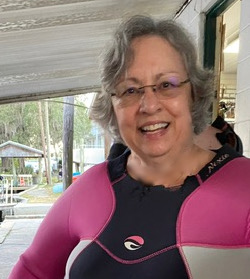
A retired teacher and mother of three adult children, I live on the Gulf Coast of Florida with my soulmate, Robert. Leisure activities include discussing current events with Robert, watching movies, and playing Scrbble. Robert usually wins! I also enjoy going to the beach and taking road trips with my daughters. One of our favorite pastimes is observing the wonderful wildlife that surrounds us. I keep busy writing poetry, and I would be delighted if you visited my website!

Animals at Homosassa Springs Wildlife State Park & Poems about Some of the Animals

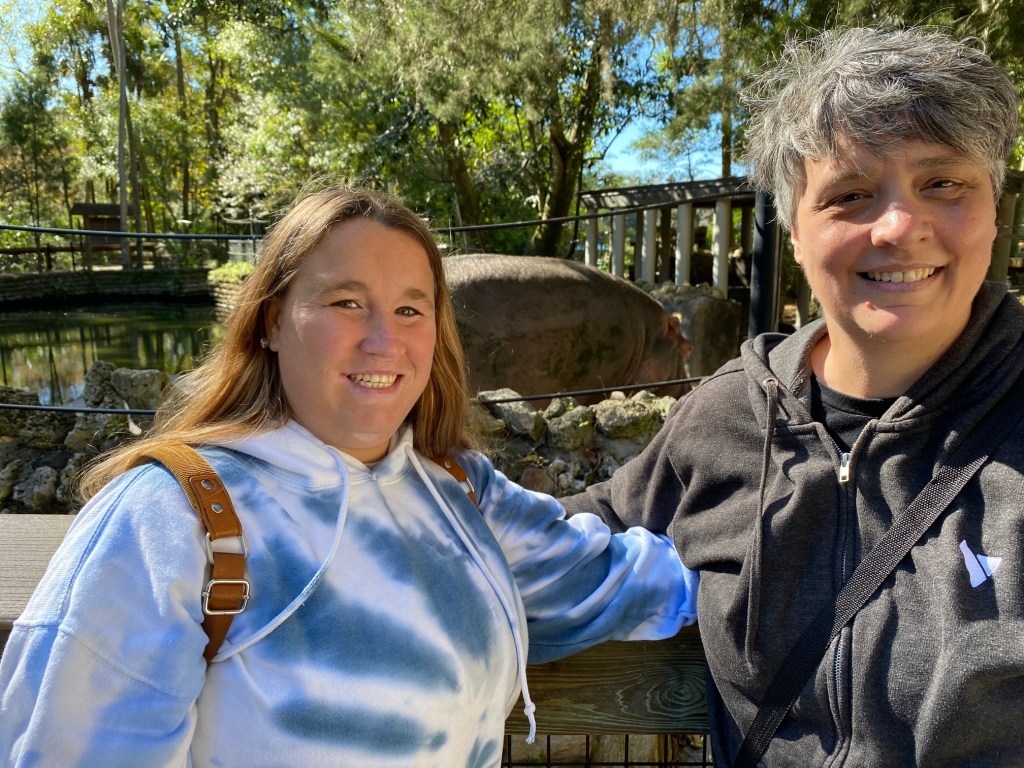
My daughters, Katey and Ellen in front of Pippa, the Hippo’s, cage. Pippa is the only exotic animal at Homosassa Wildlife State Park. The beloved sixty-one-year-old hippo was granted official Florida citizenship by the governor of Florida when the zoo transitioned to a wildlife park for Florida animals many years ago.

The majority of the animals at Homosassa Wildlife State Park are rescued animals that are unable to survive in the wild: manatees injured by boat propellers being rehabilitated in the manatee rescue center, animals who were hit by cars, birds unable to fly because of impaired vision or injuries to their wings, endangered squirrels and other rare animals raised illegally in captivity and confiscated from their owners.

The whooping cranes were from a program to reestablish these endangered birds in Florida. The female whooping crane has impaired vision and cannot fly. The male found her at Homosassa Wildlife State Park and joined her in her enclosure. He could fly away, but he stays. Whooping cranes mate for life, and this is a very touching pair!

The tropical bird enclosure, like most of the enclosures, is open at the top. It has a stream running through it and is shaded by lovely trees. I saw egrets, once hunted almost to extinction for their mating plumage, flying into and out of the enclosure. They are free to visit, or maybe they are choosing to live there.

The marine fish seen from the underwater observatory under the main spring migrate seasonally, as do the manatees in the Homosassa River near the hot springs. Public boat travel is restricted in this area to protect these migratory animals.

American flamingos, extinct in Florida for over 100 years, were discovered about ten years ago living in the Florida Everglades. No one knows for sure how they got there, but they probably came from Central or South America. We are thrilled to have them living in the wild in Florida once again. I don’t know if the flamingos in the tropical bird enclosure are rescues or are part of an effort to reintroduce them to their former range.

Alligators, hunted almost to extinction for their hides, are now protected and are once again plentiful in Florida. Programs now collect a few young alligators from their nests, raise them to a size where they can defend themselves from predators, and release them to ensure their continued success in the wild.

The black vultures, handsome lively birds, live at the park by choice, but they are a welcome clean-up crew. We saw them stealing what appeared to be fresh-cut grain from the hippo after they ate the insects from his back. We saw them visiting the black bear and perched in the trees.

The red wolves are endangered and are part of a captive breeding program to reintroduce them into Florida.

Florida Panthers, proud symbol of Florida, are endangered and seriously inbred. Panthers from Texas were brought in a few years ago to refresh the gene pool. Along Route 75, “Alligator Alley,” that runs from east to west through the Florida Everglades, high fences have recently been erected to protect panthers from traffic.

The aging dike at Lake Okeechobe has undergone extensive renovations this year. Nutrient-rich water released from the lake has caused red tides in the Gulf of Mexico and blue-green algae overgrowth in our rivers, sickening people, killing fish, dolphins, endangered manatees and endangered sea turtles. From now on, water will be released from the lake into bodies of water in much smaller amounts. The water from Lake Okeechobe will once again flow into the Florida Everglades as it was intended to do. I think Wildlife numbers will increase there due to this restoration.

I hesitated to provide detailed background information in this post. After all, I only spent half a day walking around the park and reading signs. That is the source of most of the information given about the park. I am not a biologist or expert on the environment, just a retired elementary school teacher and amateur poet who loves animals and cares about wildlife and the environment. I have done some research on wildlife to write my enviromnent-themed book series about Florida animals, Hanging Out with Wild Animals. You can read more about the books on my website.

It is tragic that so many animals have been injured and driven to extinction by human settlement and human activities, but the animals who live at Homosassa Wildlife State Park, though disabled, help to raise public awareness of wildlife and environmental issues. As the sign says, they are “ambassadors of wildlife.”


Animals at Homosassa Springs

Wildlife State Park
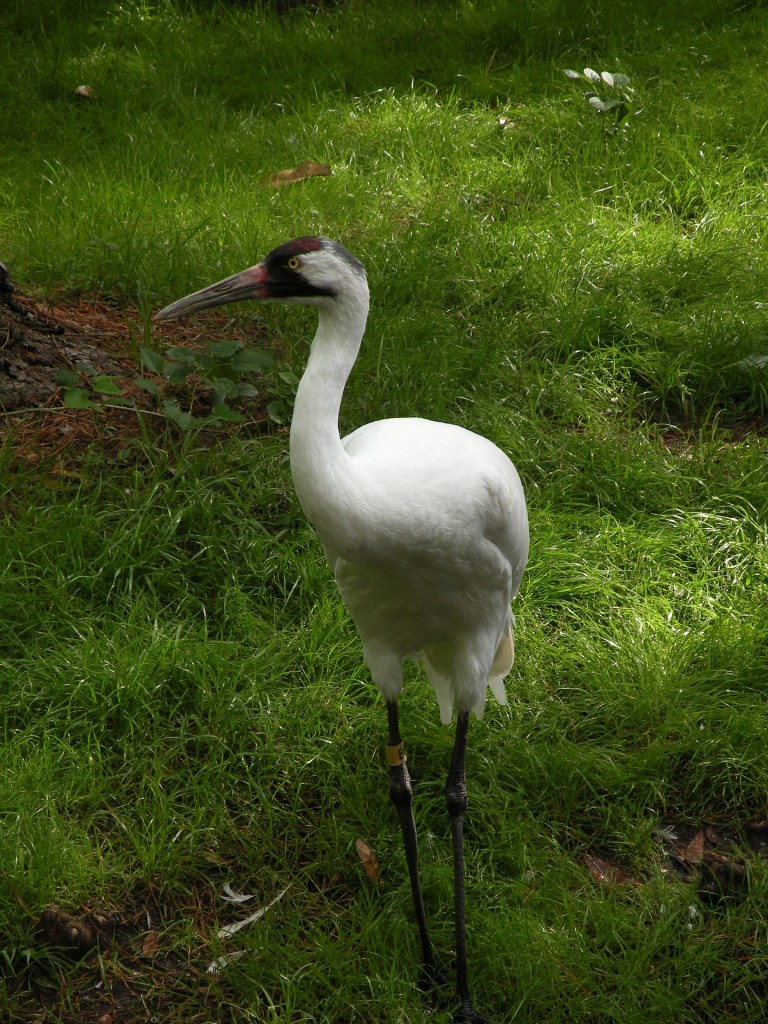
Endangered whooping crane. Photo by Amber Langeloni from Pixabay.

Love Birds

Male whooping crane joined

flightless female whooping crane

in her enclosure.

He could choose to fly away,

but he loves her, so he stays.

River otter. Photo by Jack Bulmer from Pixabay.

River Otters

You’ve got to be quick

to capture river otters

with your camera.

Appearing, disappearing

through plants on water’s surface.

Bald eagles. Photo by Jonathan Cooper from Unsplash.

Bald Eagle, National Bird

It’s been a long time

since these two injured eagles

soared Florida’s skies

American flag above ,

they watch as life passes by.

A school of snook viewed from the underwater observatory at the main spring of Homosassa State Wildlife Park. Photo by Ellen Maher.

Migrating Marine Fish

In the wintertime,

marine fish, like manatees,

migrate to hot springs.

Manatees and marine fish

thrive in seas and fresh water.
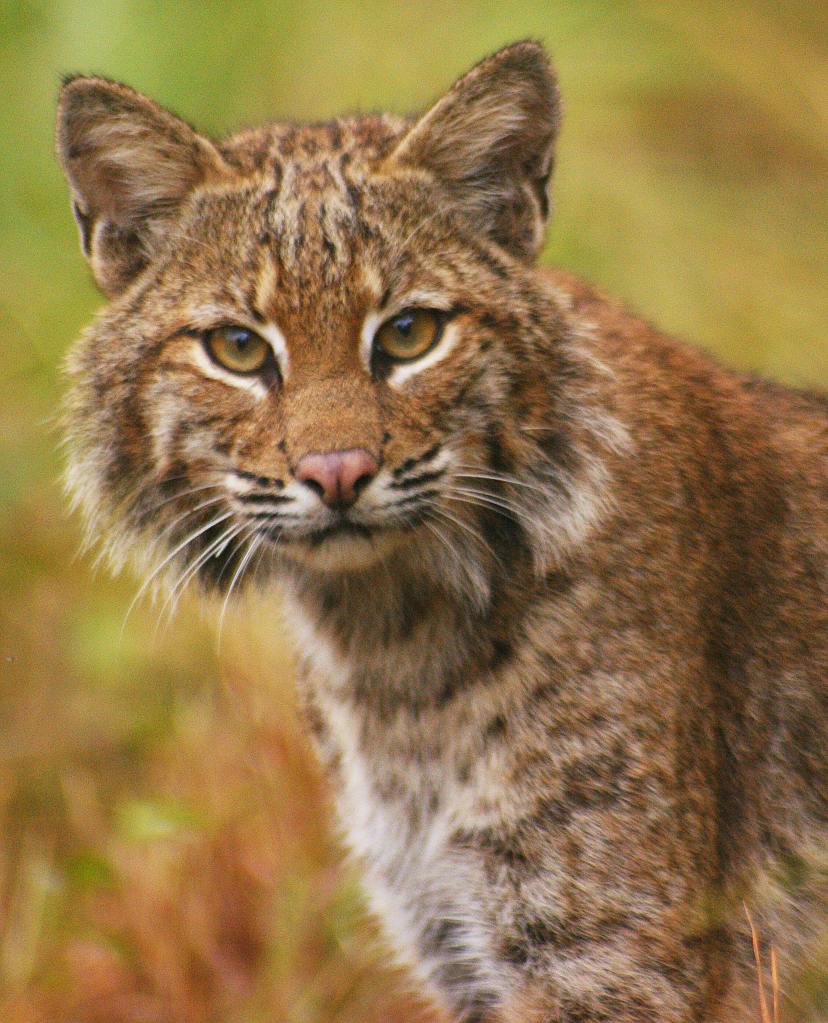
Florida bobcat. Photo by Meg Jerrard from Unsplash.

Bobcats & Florida Panthers

Florida bobcats

now coexist with humans

in suburbia.

Florida panthers, pride of

Florida, are endangered.

Flamingos in the tropical bird area. Photo by Ellen Maher.

Egret and roseate spoonbills. Photo by Kurt Anderson from Pexels.

Tropical Birds

Sparkling waters flow

through green paradise,

home of tropical birds.

Pink flamingos and spoonbills,

night herons, and sleeping swans.
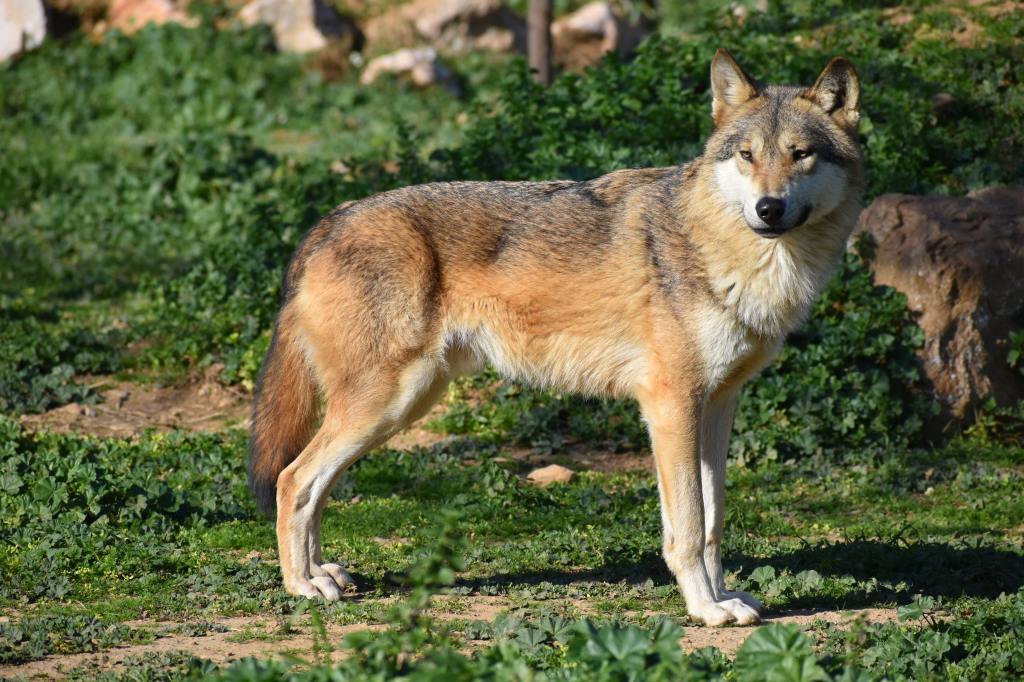
Red wolf. Photo by Lucie Sa Vi from Unsplash.

Red Wolves

Endangered red wolves

roam a spacious enclosure,

delighting humans.

Procreation their purpose…

red wolf repopulation.

American alligator. Photo by Katey Batavia.

Alligators

Alligators live

in a pond that’s metal fenced…

Visitors are safe.

Prehistoric predators…

fearsome reptiles captivate.

Black vultures. Photo by Ellen Maher.

Black Vulture Family

Handsome black vultures

choose to live at the preserve…

welcome scavengers!

Perching on the hippo’s back,

they eat insects, then share his food.

Pippa, the hippo at Homosassa State Wildlife Park. Photo by Katey Batavia.

Pippa, the Hippopotamus,

Age Sixty-One

Grandfathered from days

when exotic animals

were in residence.

Citizen of Florida,

world’s oldest captive hippo.
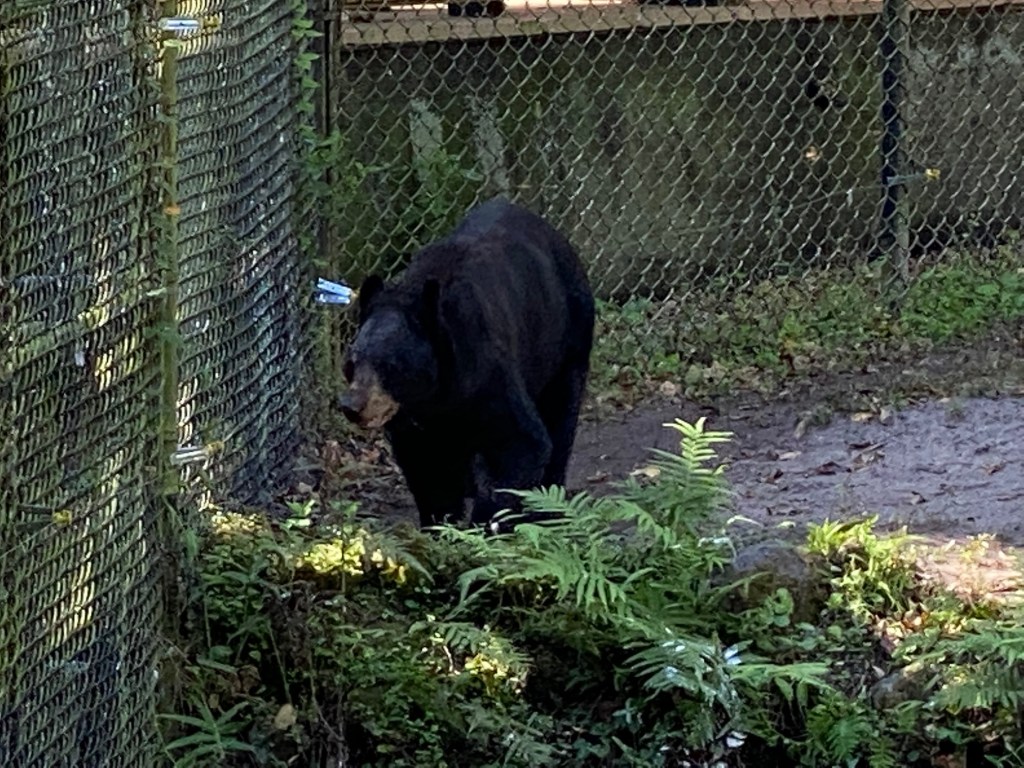
American black bear. Photo by Katey Batavia.

Ambassadors

of Florida Wildlife

Most animals here

are unable to survive

living on their own.

Protected, they now serve

as ambassadors of wildlife.

Rare, endangered squirrel now unable to live in the wild because it was illegally raised in captivity. Photo by Ellen Maher.


Copyright© 2021 by Cheryl Batavia


For more information:

floridastateparks.org

Find a Park:

Ellie Schiller Homosassa Springs Wildlife State Park

Swimming with Manatees

Katey Batavia & Ellen Maher in their wetsuits and ready to board the pontoon boat.

Swimming with Manatees

During the summer, manatees

wander widely in warm seas.

Manatees throw fall and winter parties

in warm springs near seventy degrees.

Hundreds of manatees socialize in Kings Bay

near Three Sisters Springs on November days.

These marine mammals enjoy each other’s company.

They don’t compete for territory.

Vegetarians, they live on sea grass…

How peacefully, how gracefully their days pass!

Nursing calves swim beside their mothers.

They have no predators, no fear of others.

Though manatees bear the scars

of encounters with boat propellers,

they still seek humans as their playmates.

Snuggles and belly rubs are appreciated.

As I climbed down the boat ladder,

a manatee waited in the water.

A thousand pounds of curiosity

and sweet manatee eyes greeted me.

The moment we came face to face,

I knew there was hope for the human race.

At that moment it was clear to me

that people could learn from manatees.

How happy life would be

if we could live in harmony

with nature and our fellow creatures.

Manatees are charming teachers!

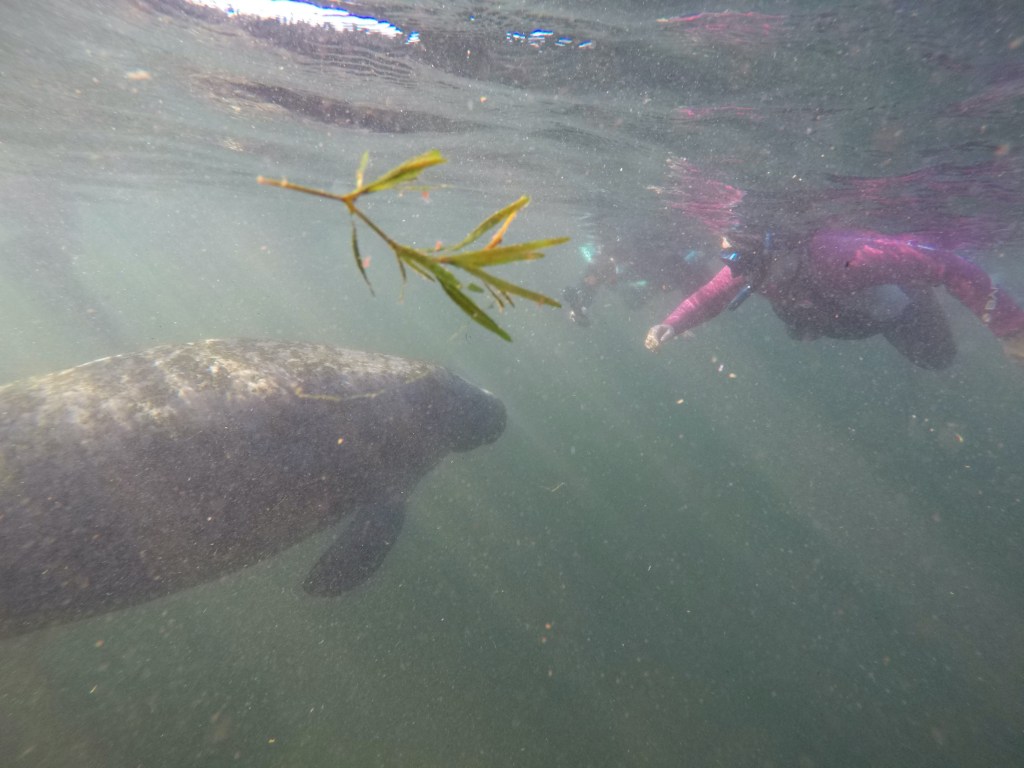
A friendly manatee. g7b148…-Suo02Vj
Ellen meets a manatee at Three Sisters Springs in Kings Bay, Crystal River, Florida. DCIM\100GOPRO\GOPR0196.JPG
A manatee asked Katey for a pat. Note the harmless algae growing on the manatee’s back. DCIM\100GOPRO\GOPR0250.JPG
Time for my belly rub, Katey! DCIM\100GOPRO\GOPR0156.JPG
Cheryl. Photo by Katey.

West Indian Manatees

West Indian Manatees are endangered marine mammals whose closest relatives are elephants. They require a minimum water temperature of sixty-eight degrees. Interestingly, they have no front teeth, only molars for chewing tough sea grass. They swim gracefully at speeds up to 20 miles per hour. At 1,000 to 1,200 pounds, they have no natural enemies, but many are injured by propellers of fast-moving boats. Boaters can protect manatees by observing posted speed limits in manatee areas.

Personnel at Kings Bay in Crystal River tag and monitor injured manatees. They are transported to a manatee rescue center in Homosassa Springs for rehabilitation if they are unable to recover on their own.

Florida has numerous hot springs where manatees spend the Fall and Winter months. Kings Bay has a constant year-round temperature of sixty-eight degrees and some manatees are year-round residents there. Other springs may be a little warmer, about seventy-two degrees.

When you swim with the manatees, you are instructed not to disturb resting manatees. As you would get to know a strange cat, you should let them approach you. Ellen had a manatee hug her arm. A manatee wanted Katey to pet it and give it a belly rub. One manatee swam up against me, and another manatee put its nose against my mask and gazed into my eyes. These are moments we will always remember!

Manatees have been called “sea cows” because they graze on sea grass and other aquatic plants. Very lonely mariners in the early days are said to have mistaken them for mermaids. There is another species of manatee in Africa.


Copyright© 2021 by Cheryl Batavia


For more information about swimming with manatees and boat tours, you can contact:

http://www.PlantationOnCrystalRiver.com

floridamanateeadventures.com

The Ringling Museum, Sarasota, Florida & A Young Boy’s Circus Dreams

Photo by Cheryl Batavia

My daughters, Ellen and Katey, on the bayfront terrace of Ca’D’Zan, the 1920s Venetian-style mansion of John and Mable Ringling. They lived and entertained in this home for 90 days a year during the winter. Sarasota was the winter home of the Ringling Brothers, Barnum and Bailey Circus for many years. A luxury private railway car, The Wisconsin, was John and Mable Ringling’s home for much of the year as they traveled around booking acts for the circus. The car, complete with stained glass, can be toured in the Circus Museum.

The mansion features stained glass windows, hand-carved, hand-decorated ceilings, and antique furnishings. My favorite room is the ballroom with its beautiful wide plank floors and gorgeous ceiling depicting dancing couples from different eras. The main room of the mansion is several stories high and has a view of Sarasota Bay through pastel-colored stained glass windows. The room has an ornate grand piano and a pipe organ that cost $25,000 in the 1920s.

Mable Ringling’s wagon wheel-shaped rose garden has approximately 1,250 antique roses, many from the 17th and 18th centuries, and is surrounded by statues of courting couples.

The sixty-six-acre estate has numerous other gardens and several museums. We spent about half a day exploring the mansion and the Circus Museum on this trip. Multiple galleries feature priceless circus memorabilia. There are elaborately hand-carved and painted antique circus wagons, calliopes, gorgeous vintage costumes made of silk and embroidered with faux gems, old circus photos, and informative and entertaining videos.

There is a 31-gallery art museum famous for its world class collection of old masters. Besides its permanent collections, the art museum hosts various exhibits. I have visited the art museum several times in the past. You could easily spend a day there. There is also an historic theater which hosts live performances.

Katey takes a selfie in front of one of the fourteen banyan trees on the estate, a gift from Thomas Edison, who raised several types of banyan trees at his winter estate in Fort Myers, Florida. In the photo: Katey, Cheryl, and Ellen.

Unless stated otherwise, photos in this post were taken by Katey Batavia and Ellen Maher.

Sculpture above the entrance to the Circus Museum.

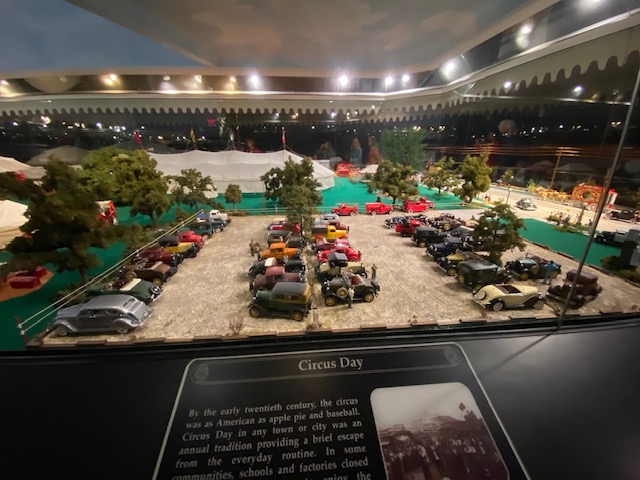
A scene from the Howard Brothers Model Circus, which recreates an early 20th century circus. Howard Tibbals, a retired circus performer, created the 44,000-piece display by hand over a fifty-year period. The display occupies 3,800 square feet in the museum.

Multiple acts took place simultaneously under the big top.

Animal acts and the menagerie allowed many people to see exotic animals for the first time.

The menagerie.

A circus parking lot filled with beautifully-crafted vintage cars. Schools and businesses shut down on circus day so that people for miles around could attend the circus.

There were side shows where people could entertain themselves with novelty acts as they waited for the circus to start under the big top.
The circus train carried the circus from town to town. When set up, the circus was like a small city. It took over a thousand workers to set up the circus and take it down. They could set the circus up in four hours for the day’s performance. Then they would tear it down and set up again in the next town. Most performances lasted only one day.

Young boys and girls all across the country loved the glamour and excitement of the circus. Many had big dreams of joining the circus someday.

A Young Boy’s Circus Dreams

Photo by Jeremiah Lawrence from Unsplash.

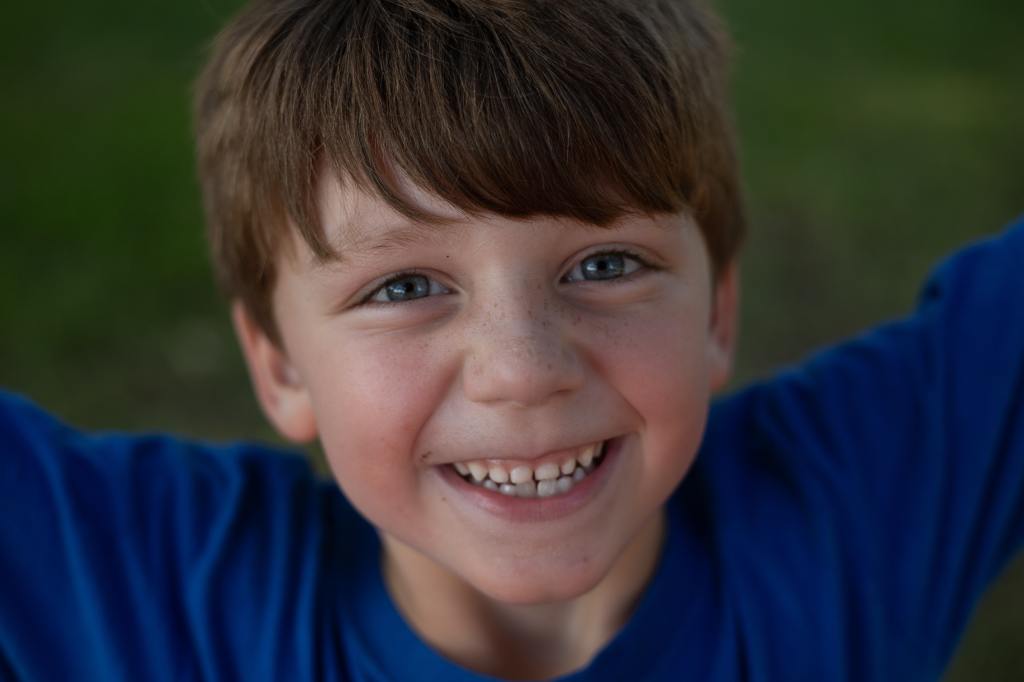
A Young Boy’s Circus Dreams

I’ll join the circus!

A ringmaster in top hat

and tails, I will say…

“Ladies and gentlemen! Children

of all ages! Welcome!”

I’ll join the circus,

ride an elephant bareback,

and teach bears to dance.

Lions and tigers will purr

when I crack my whip and grin!

I’ll join the circus,

a goofy clown…folks laughing,

watching me fall down.

I’ll honk my red nose, driving

crazy in my tiny car!

I’ll join the circus!

Wearing flashy spangled tights,

I’ll walk the high wire,

and catch flying girls from my

high trapeze…Crowds will go wild!

I’ll join the circus

and see the world from a train…

each day, a new town!

I’ll come home for vacation…

fish all day…eat Mom’s peach pie.


Ellen in a tiny car in the interactive exhibit.
Katey, trick rider, interactive exhibit.

Copyright© 2021 by Cheryl Batavia


May All Your Days Be Circus Days!

Upcoming posts will feature more adventures from our travels during Thanksgiving week. It was so good to see my daughters again, and we had a fabulous time!

For more information about The Ringling Museum, visit their website, ringling.org

“A Great Miracle Happened Here!”

A Poem about Hanukkah, a Jewish Holiday beginning this year on November 28

Jews celebrate the eighth night of Hanukkah. Eight candles burn in a menorah. The ninth candle in the center is used to light the other candles. Photo by Rodnae Productions from Pexels.

“A Great Miracle Happened Here!”

Hanukkah menorah lights burn bright.

Just one candle is lit on the first night,

two on the second, three on the third…

On the last night, all eight are burned!

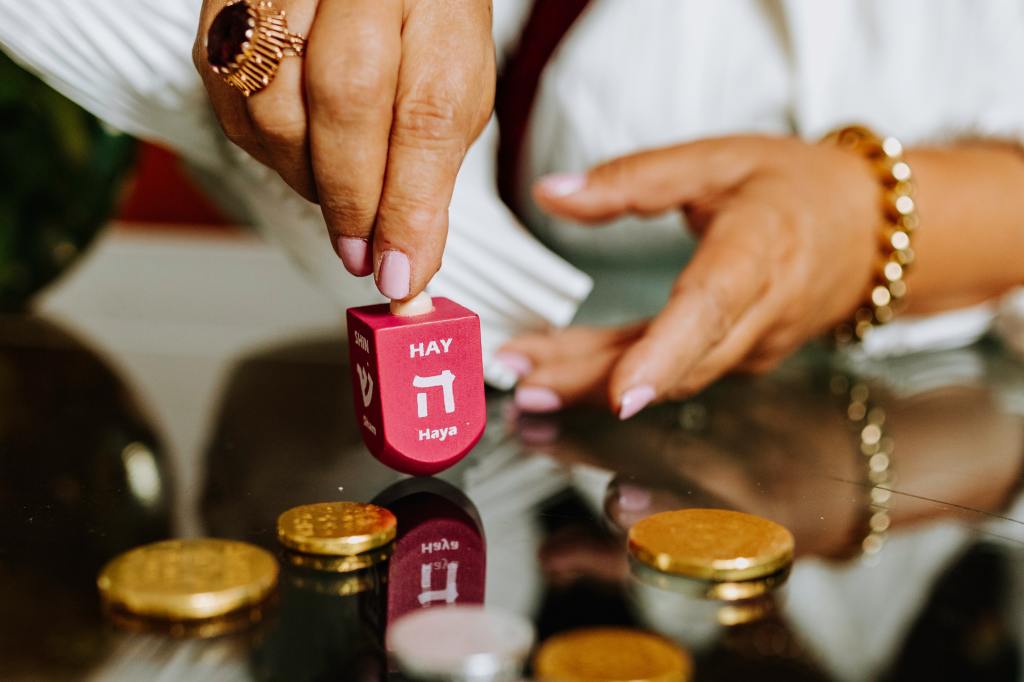
A woman gambling for Hanukkah gelt, spinning a dreidel. The letters inscribed on dreidels stand for, “A great miracle happened here!” Photo by Rodnae Productions from Pexels.

Spin the dreidels…Their message is clear:

“A great miracle happened here!”

Tell the Hanukkah story, please,

of Jerusalem reclaimed by the Maccabees.

Drawing the Star of David. Photo by Cottonbro from Pexels.

In Jerusalem, the temple’s rededication

was cause for joyous celebration.

They had enough oil to burn for only one day…

but for eight days, the temple lamps blazed!

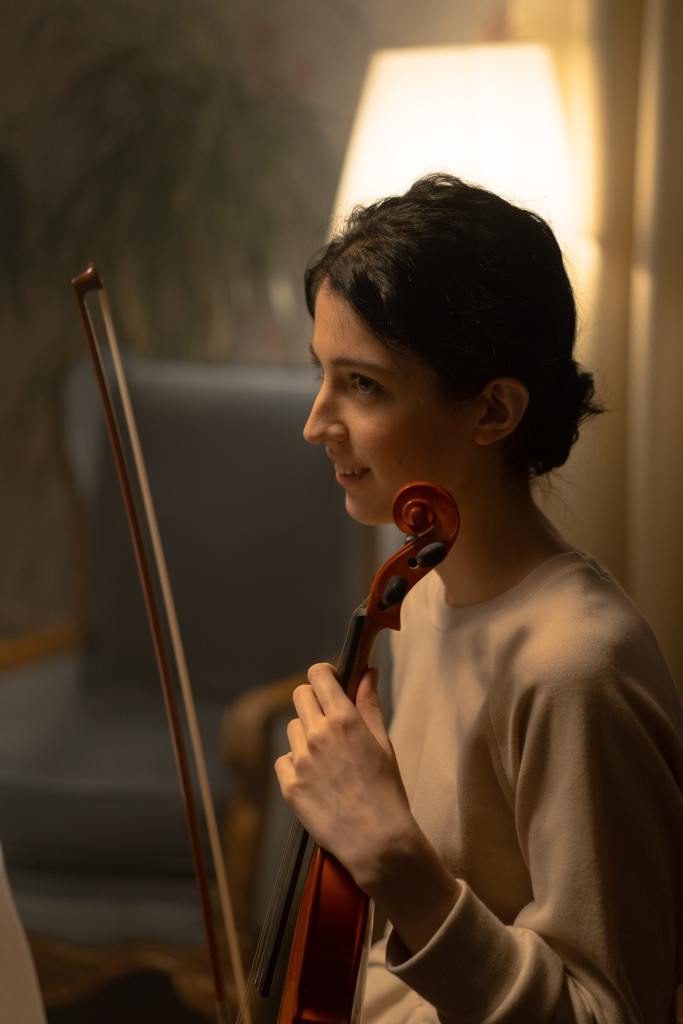
Photo of a violinist by Cottonbro from Pexels.

Bring out the latkes, sing the songs.

Hanukkah celebrations are eight days long!

Love of religious freedom is heartfelt,

holiday memories as sweet as Hanukkah gelt!

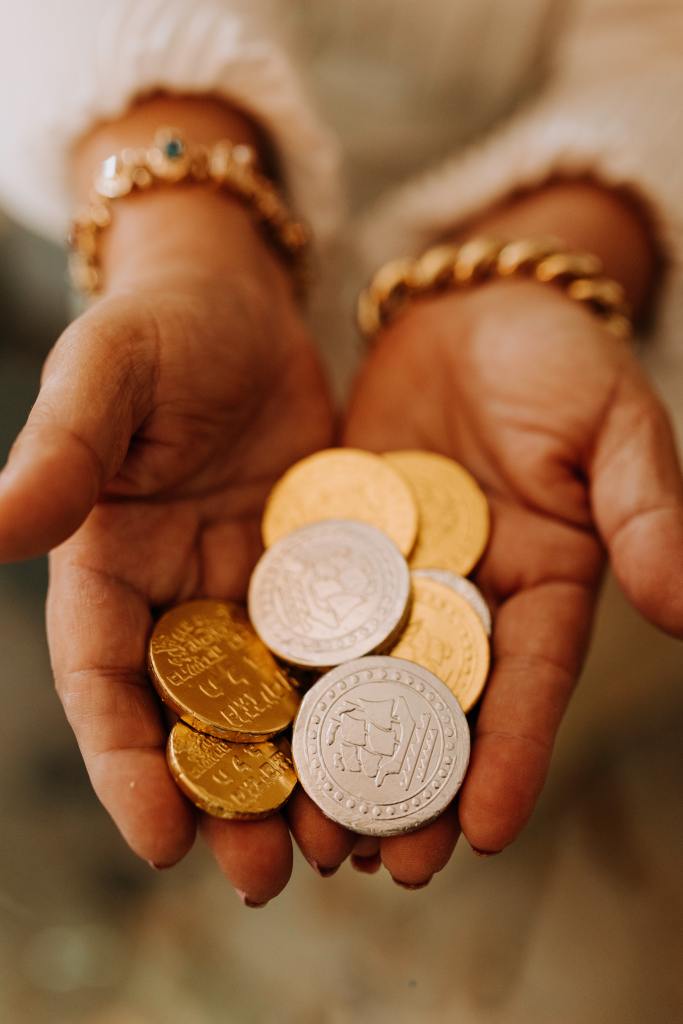
Hanukkah gelt, chocolate coins covered in foil. Photo by Rodnae Productions from Pexels.

Copyright© 2021 by Cheryl Batavia


The events commemorated by Hanukkah occurred about 167 BCE. The history of the period is very complex, but well worth learning more about. I especially like the story of Judith, a spy who helped win the war to reclaim Jerusalem. Hanukkah is generally viewed today as a celebration of religious freedom.

For a poem about Hanukkah as celebrated by our family when our children were young, see “Eighth Night of Hanukkah.” https://gulfcoastpoet.com/2020/12/02/eighth-night-of-hanukkah/

Happy Hanukkah!

We Are Thankful

by Ellen Maher

Photo by Brad West from Unsplash.

We Are Thankful

We pilgrims are thankful

For what you have brought us

We were strangers in a land that was not our home

With your help we have made it

Through the barren winters

We know in the cold to come, we’re not alone.

I thank you for what you have done

I thank you for the rain and the sun

I thank you for the seeds to sow

I thank you for the way you make it all grow

Photo by Suzy Brooks from Unsplash.

We pilgrims are thankful

For the foods that feed us

For the time to be together

The harvest is here now

And the food is gathered

You have made us ready for any kind of weather

I thank you for what you have done

I thank you for the rain and the sun

I thank you for the seeds to sow

I thank you for the way you make it all grow

Ellen Maher and Katey Batavia

LN Maher

©1996 Echoes of the Lion’s Roar

http://lnechoes.blogspot.com/


My daughters, Ellen Maher and Katey Batavia will be visiting over the Thanksgiving week, November 21-27. I am so excited to see them for the first time in almost two years! I will be off WordPress to spend some time with them. A swim with the manatees at Crystal River is planned. It was canceled last time because of Covid 19. We are eagerly looking forward to the trip.

The poem above was written by Ellen. She is an ordained Baptist chaplain and a teacher and administrator in a recovery program that deals with issues such as grief, addiction, and illness. She also volunteers for many special projects at her church. This year she helped to produce a video for a virtual Vacation Bible School during the pandemic. Ellen writes religious poems on her blog, Echoes of the Lion’s Roar.

Happy Thanksgiving!

West Indian Manatee. Photo by Maegan Luckleish from Unsplash.

Message in a Bottle

A Fantasy

Photo by Scott Van Hoy from Unsplash.

Message in a Bottle

A Fantasy

A barefoot wanderer on the sands of time,

moment to moment, no reason or rhyme,

searching for a message in a bottle along the shoreline,

but pebbles on the beach were all I could find.

Looking for the light of my life, year after year,

I sang along with the music of the spheres,

seeking someone to sing with me as we embark,

two-by-two onto an archetypical ark.

I rowed my small boat…on dry land I planted my feet.

Miracle of miracles, soon we were dancing cheek-to-cheek!

All was bright where once were darkness and strife.

I smiled at you, the light of my life!

From each rising sun to the next rising sun,

on top of the world, under the gun,

or tossed by capricious seas, we’ve had a good run.

We’ve sailed life together, and it’s been fun!

Hand-in-hand on the beach we walk as before;

a message in a bottle washes up on the shore.

With hearts aflutter and chaos of mind,

we uncork the bottle, unsettled by what we find.

With the music of the spheres our hearts are attuned,

but the message in the bottle portends impending doom.

It says, “Tis a short voyage from cradle to tomb.”

We face an epic tidal wave…The end has come so soon!

Photo by Kampus from Pexels.
Photo by Jeremy Bishop from Unsplash.

Copyright© 2021 by Cheryl Batavia

Valued Possessions

Photo by Kelly Sikkema from Unsplash.

Valued Possessions

Forest

fire! Flames creeping

down the mountainside.

Air smells smokey in our yard.

We load our car with our treasures…

Fifteen photo albums,

our life story…

valued!

Forest

fire extinguished!

Smoke and fear dissipate.

We unpack our car with smiles and

new insights of what we value…

Family history,

daughter’s childhood…

valued!


Copyright© 2021 by Cheryl Batavia


One Saturday about forty years ago, when my husband was at work, my young daughter, Ellen, and I watched fire and smoke moving down the mountainside toward our house. We packed our car with something irreplaceable…our photo albums. My fifty-two-year-old daughter still has those albums, memories of her childhood.

An Album of Childhood

Photo by Joice Kelly from Unsplash.
Photo by Romina Veliz from Unsplash
Photo by Josh Applegate from Unsplash.
Photo by NeonBrand from Unsplash.

Photo by Deb Dowd from Unsplash.

Photo by Prince Abid from Unsplash.
Photo by Robert Collins from Unsplash.

Little Human vs. Global Destruction

In Response to the Climate Summit

Photo from Pexels.

Little Human vs. Global Destruction

Global Destruction, a villian

about as bad as they come,

believed his evil takeover plan

was too big to be undone.

“What do I care, little human,

for your miniscule potential?

Do what little you can;

it’s quite inconsequential!”

Joy sprang like a weed

in the little human’s heart.

He knew humans could succeed

if they all did their part!

Photo by Markus Spiske on Unsplash.

Copyright© 2021 by Cheryl Batavia

Ghosts of Halloweens Past, Reblog

Photo by Taylor Rooney from Unsplash

Ghosts of Halloweens Past

Cauldrons of magic potions steaming,

Black cats awakening from dreaming.

Cardboard witch astride her broom

cackles under the harvest moon.

Disney princesses in jeweled crowns

are panhandling all over town.

Frankenstein’s monster is resurrected.

Roaming mummies have been detected.

Blow-up ghosts hover mysteriously,

orange lights twinkle in shrubbery.

Hanging from the live oak trees,

paper skeletons dance in the breeze.

Photo by Conner Baker from Unsplash

Spooky music is beckoning,

roving children are threatening,

“Trick or treat! Trick or treat!”

on every suburban street.

Little pirate brandishes a toy sword,

winning him a sweet reward!

Cat Woman says,”Thank you.”

Neighbor says,”Have fun, you two!”

Jack o’lanterns glow,

grinning at the passing show.

Flickering candles beneath

backlight their jagged teeth.

Vampires in windswept black

pantomime a plastic-fang attack.

Howling werewolves with hairy arms

induce us to pretend alarm.

A little troll walks with a giant bunny.

Funny thing is, he calls her “Mummy!”

Diminutive dragons are holding hands

with a Cat-in-a-Hat they call “Dad!”

Wolfing down all the candy they can eat,

Halloween’s children fall blissfully sleep.

Mom chews bubblegum. Dad eats M & Ms.

“Oh no! We can’t stop! When will it all end?


Copyright© 2020 by Cheryl Batavia