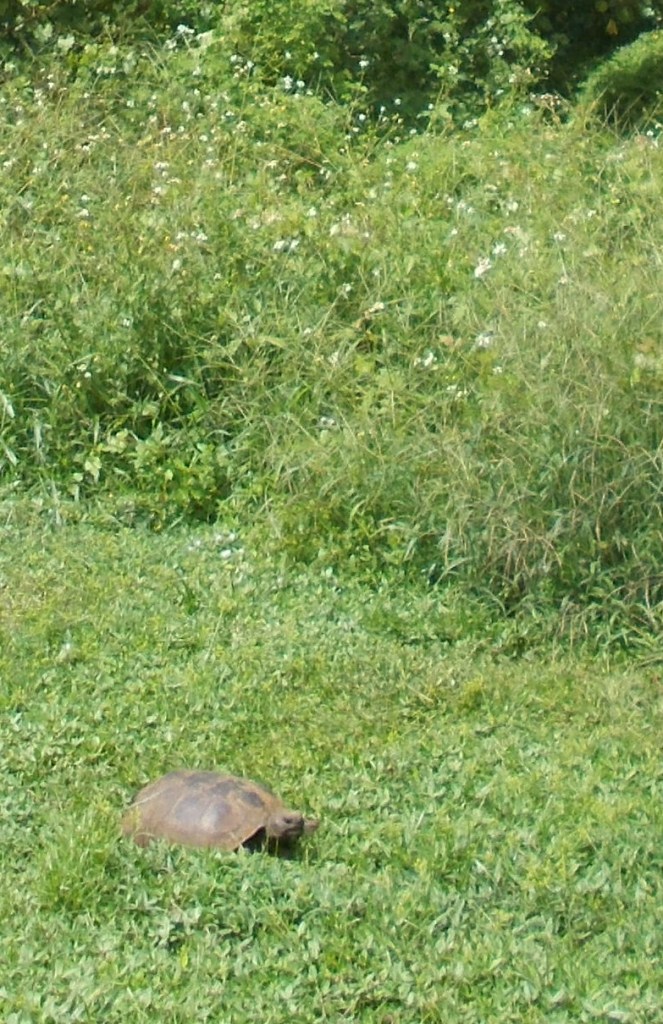
What a delightful visitor! All the rain has made it difficult for landscapers to keep up with mowing. This gopher tortoise noticed and paid us a visit. Robert found the tortoise grazing on our weedy, overgrown lawn next to the woods.
Gopher tortoises build extensive networks of underground burrows which they use for many generations. Other small animals also use these burrows. Many houses are being built in our largely wooded neighborhood, and the habitat of these endangered tortoises is rapidly disappearing.
Gopher Tortoises Displaced is my first garland shardoma.
A big thank you to David, who blogs at The Skeptics Kaddish, for talking me into writing a poem in this form. It was great fun writing this, David! ❤
A garland shardoma has seven verses. Each verse has a syllable count of 3/5/3/3/7/5 and is unrhymed. The seventh verse is composed of lines taken from the other verses.
Animals in many places are responding to climate change by changing their behaviors. Warming seawater has resulted in a decrease in the number of krill, a tiny shrimp that is the primary food of humpback whales.
One group of whales have adapted by finding a new food source, salmon fry from a hatchery in British Columbia whose mission is to replenish the dwindling salmon population. One whale changed his diet from krill to salmon fry. He feasted when the salmon fry were released from their net enclosures.
Humans then started transporting the fry a mile away to release them. The whale followed the boat and adapted by learning to fish in the shallow water. Then he recruited a team of his buddies to fish in teams as dolphins do. I guess the hatchery will have to produce a much larger crop of salmon fry to feed the hungry humpback whales and still have enough salmon for human fishermen!
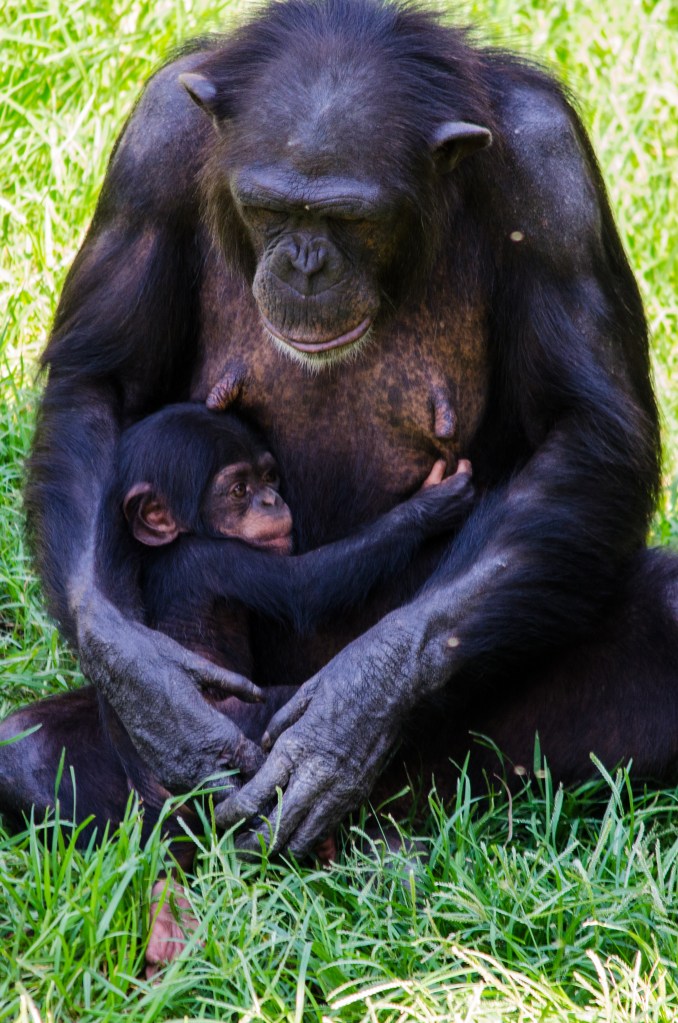
A group of forest chimpanzees migrated to the savannah of Senegal. The climate was hotter, there were fewer trees, and sources of food were far apart. The chimps responded to the heat by growing less body hair. They established larger territories. Because there were fewer trees, chimps spent more time walking upright than their forest relatives, who usually travel by swinging through the treetops.
Because there was less fruit to serve as a source of water, they had to find fresh water sources. To purify mucky water, they learned to dig holes in sandy riverbanks. When the water filtered through the sand, the holes were filled with clean water for the chimps to drink.
As a source of protein, the savannah chimps use twigs to fish for termites, spending much more time in this activity than forest chimps do. In the middle of the day, when weather is hot, these chimps seek shelter in caves, as early humans once did.
As the climate warms, the savannah will become many degrees hotter. Water sources will dry up. Life will become even more difficult for the savannah chimps. Will they be able to survive?
Marine Iguanas, famously studied by Charles Darwin, live in the Galapagos Islands, a harsh environment. To survive hot weather, they shrink their bodies. In cooler periods, they regrow to their usual size. Too long in cold water, iguanas face hypothermia, which can be fatal. Can marine Iguanas survive global warming?
For more information, watch the PBS video on YouTube, “Earth is Changing (and Animals are Adapting in Surprising Ways.)” Evolution Earth
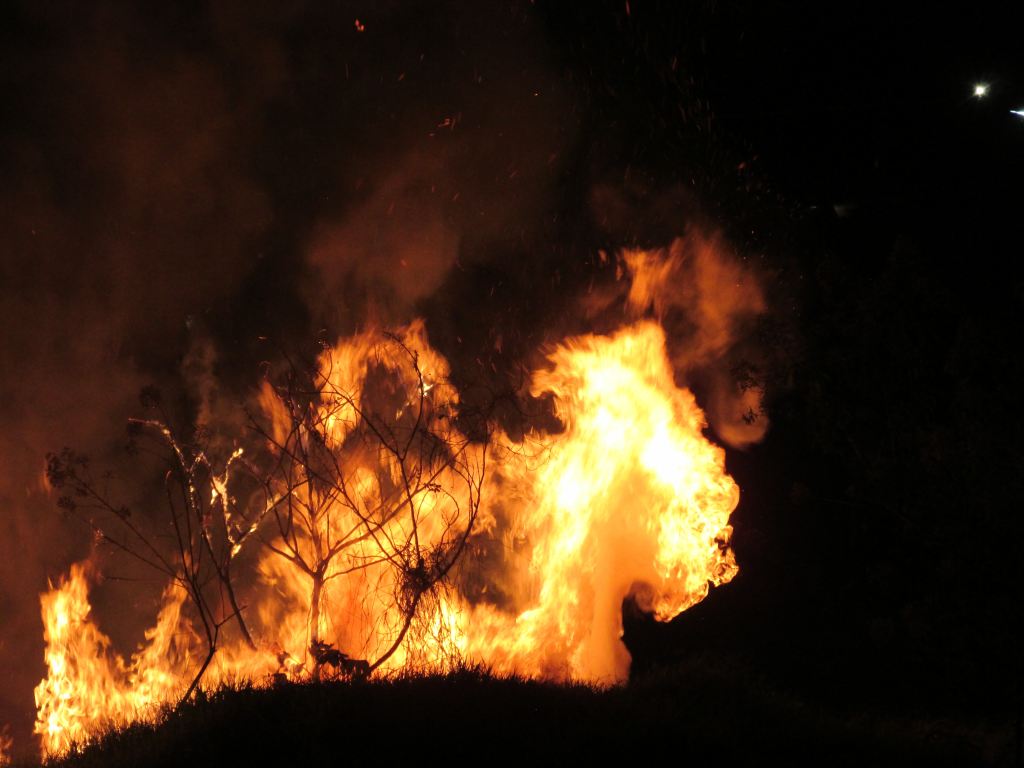
Ruins of Great Western Iron Smelting Furnace, Tennessee, 1855-1856. The furnace burned charcoal, and temperatures in the furnace reached 3,000 degrees F. Photo used by permission of the photographer.
Let There Be Light
Where there is sunshine,
let there be solar farms…
Let there be light!
Solar farm in Germany. Photo by Marcus Spiske from Unsplash
Where there is wind,
let there be turbines…
Let there be energy!
Wind Turbines. Photo by Jason Blackeye from Unsplash
Where there is flowing water,
let there be hydroelectric plants…
Let there be power!
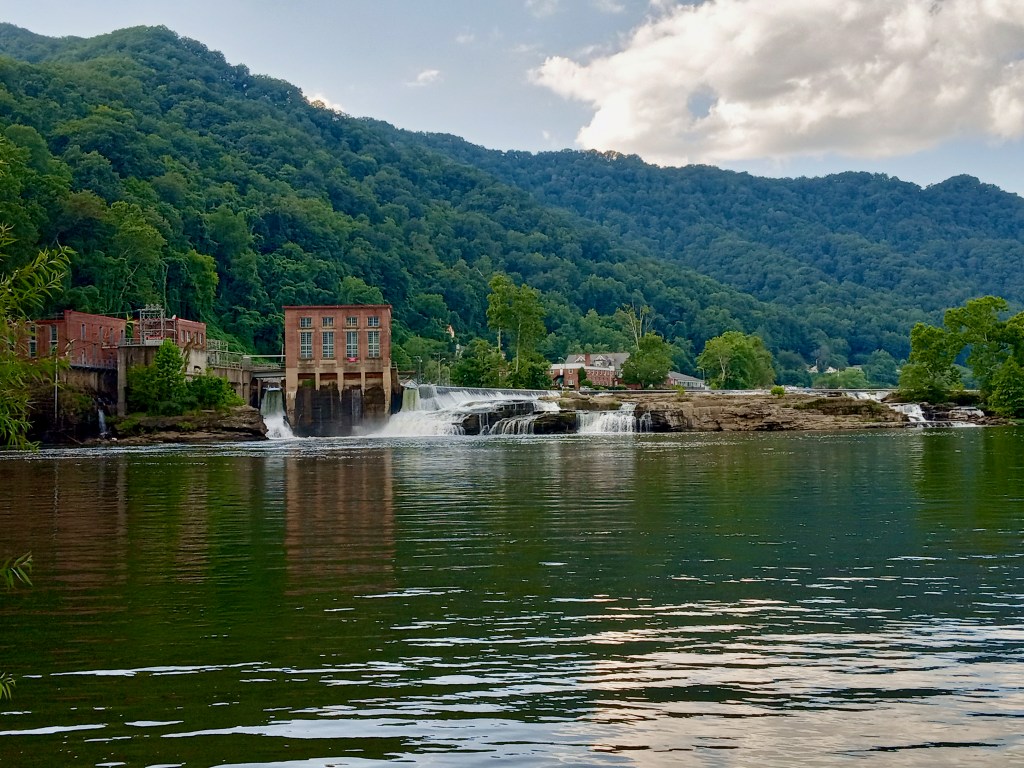
Vintage Hydroelectric Plant, West Virginia. Photo courtesy of the photographer.
Where there are ocean waves,
let there be wave-power generation…
Let there be electricity!
Gulf of Mexico, Florida Beach. Photo by Eve Ellen Maher
When people travel,
let them drive electric cars…
Let there be zero emissions!
Charging station in the Netherlands. Photo by Fer Troulik from Unsplash
Where there is imagination,
let there be innovation…
Let there be clean energy!
Photo by Alessandro Bianchi from Unsplash
Wherever children have dreams,
let their dreams be fulfilled…
Let there be clean energy for all!
Photo by Nathan Dumlao from Unsplash
A Clean-Energy Future
Although we might like an instant, one-size-fits-all source of clean energy, it may not exist. It seems that we need to work with mother nature to develop solutions using local resources. It also seems that reducing the use of fossil fuels will be a gradual process. We will continue using some fossil fuels for quite some time.
Mine cave-ins, black lung, oils slicks, acid rain, micro-plastic waste in our food supply and our bodies, toxic petrochemicals in insecticides and household cleaning products, landfills filled with non-biodegradable plastics, water pollution, smog, and climate change are a few of the problems associated with fossil fuels. Fossil fuels threaten our environment and pose risks to our health.
Clean-energy solutions have problems too. Dams can disrupt ecosystems and cause extinction of species; solar panels require rare minerals to manufacture them and have a limited lifespan; some wind turbine designs are hazardous to birds.
Heat pumps, geothermal heating systems, and river turbines are examples of clean- energy systems that may be useful in certain locations. Older river turbines were hazardous to fish, but newer designs don’t harm them.
Electric cars, one important clean energy measure, currently have a top range of 300-500 miles. There are insufficient numbers of charging stations at the present time. Batteries have been manufactured with toxic ingredients that present disposal problems. Scientists are currently developing batteries with cheaper, non-toxic chemicals and greater range between charges. A too-rapid increase in the number of electric vehicles would overburden energy grids.
Atomic power plants, which use nuclear fission, are subject to melt-downs and radiation leaks. Fission has great destructive potential. Nuclear fusion holds promise for the future as a safer alternative, if it can ever be made practical.
There are no simple fixes. Solving our problems requires dedication and commitment. It requires cooperation among many professions and among all nations.
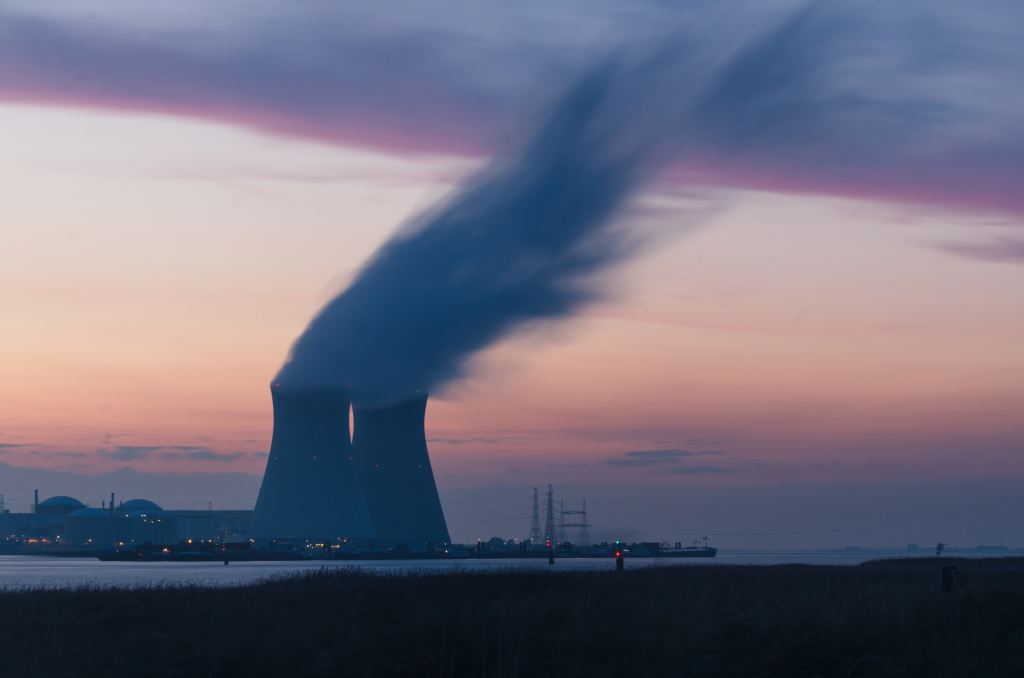
Atomic Power Plant, Belgium. Photo by Frederic Paulussen from Unsplash
*My thanks to Robert Snyder for consulting on this article. There are many YouTube videos about developments in clean-energy technologies.
Vacant wooded lot next to our house before Hurricane Ian. Live oaks and native cabbage palms grew there. Purple Ruellia, probably planted by a homeowner twenty years ago, grew naturalized along the edge of the woods.
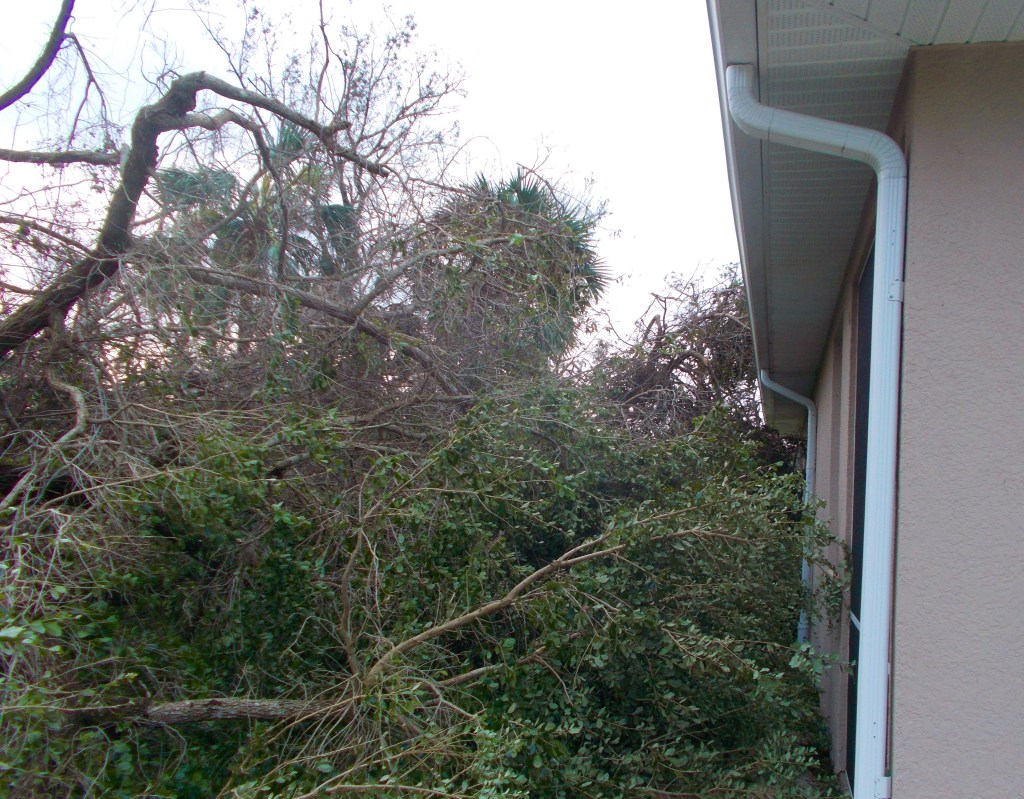
September 28, 2022. Hurricane Ian, the worst hurricane ever recorded in Florida, threw the trees from the wooded lot next door onto our yard and house.
Early October, 2022. Fallen trees were cut back to the property line. This is the horrific scene by moonlight…a battered, leafless oak tree and a tangle of fallen trees and broken branches.
December, 2022. Oak trees all over our region, stripped of their leaves by Hurricane Ian, were blooming and sprouting new leaves two months ahead of their usual schedule. The fallen trees were still alive and sprouting hundreds of new branches. Sun-loving wild shrubs were growing on the formerly shady wooded lot.
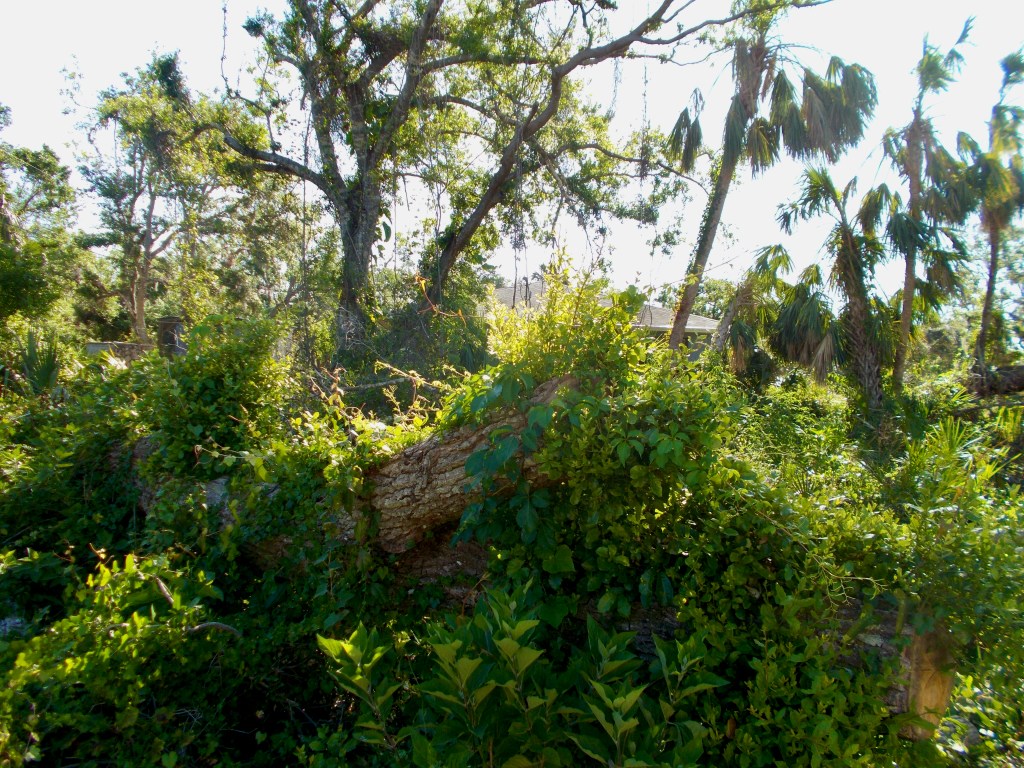
July, 2023. Nature has blanketed the fallen trees and broken branches in green vines. Beautiful Saint Augustine grass that was barely surviving in the shade of the trees has appeared in our side yard. Purple Ruellia flowers are reappearing along the edge of the former woods.
Nature has a long timeline. If no one builds a house on the lot, it will again be filled with oak trees. It might take 50 years! The largest and most beautiful oak tree that used to be there was probably much older than that!
July, 2023. Broken trees are cloaked in green leaves. Our house has a new roof. Exterior wall cracks have been repaired and walls are freshly painted. Interior hairline cracks still need repair and touch-up paint. It is difficult to find someone to do any work. Contractors continue to be very busy, even with some out-of-state companies still working here!
Our roads have traffic signals again, but, almost a year after Ian, there are many missing street signs. It is easy to get lost! We are still in suspense about how much our homeowner’s insurance may increase due to Hurricane Ian.
Mostly, we are grateful to be living in a comfortable, air-conditioned house as summer heat sets new records here and worldwide. Many people are not so lucky.
Now, is the time to address global warming! If I weren’t convinced of that already, the worsening storms, wildfires, heat waves, and floods occurring around the world this year would convince me!
Please Note: This post was written from my own experiences in Florida. I learned about environmental topics from news and documentaries, and I did some basic research while writing poems about Florida animals. I am not a scientist, just a retired elementary school teacher who cares about the environment.
It’s a big world! Please feel free to provide additional information from your experiences and perspective in the comments. Thank you. 🙂
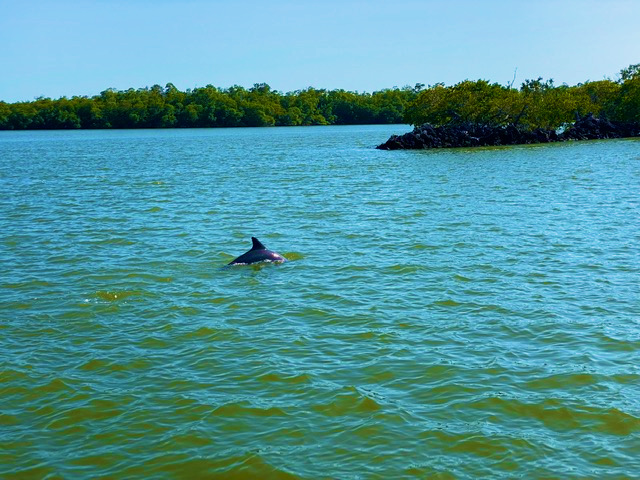
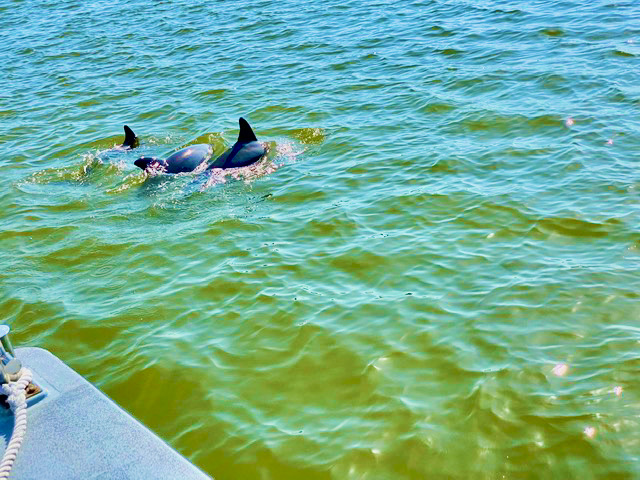
A bottlenose Dolphin surfaces at Ten Thousand Islands, Everglades National Park, near Florida City, Florida. Dolphins here are smaller than those in the open ocean, and water tends to be shallow, about eight feet deep in most places. Mangrove islands are in the background. Photo by Katey Batavia.
In the Mangrove Forest
Serenely we sail over sparkling seas
under a cloudless, boundless, bright, blue sky.
Aloft, uplifted by auspicious breeze,
above green mangrove islands, ospreys fly.
Calusas in canoes once feasted here;
shell middens at campsites made islands rise.
Homesteaders came, some island land to clear,
but nature soon reclaimed her paradise.
In wakes of boats, the friendly dolphins play,
delightful as they were in olden days!
Shell Middens
Shell middens are mounds of shells left behind from Native American seafood meals. The mounds may also contain bones, pottery shards, and other discarded materials. At Ten Thousand Islands, you can identify islands with shell middens by their slightly higher altitude. Trees grow atop the middens, rising above the surrounding mangroves.
Osprey chicks are growing up in a nest of sticks built atop this sign and safe from most predators. Everglades National Park, Ten Thousand Islands, near Florida City, Florida.
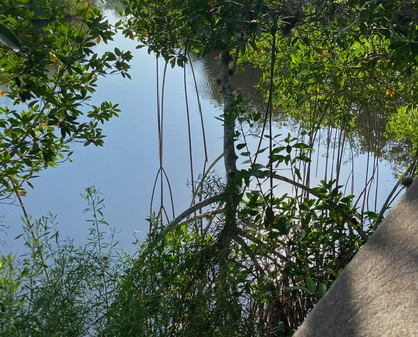
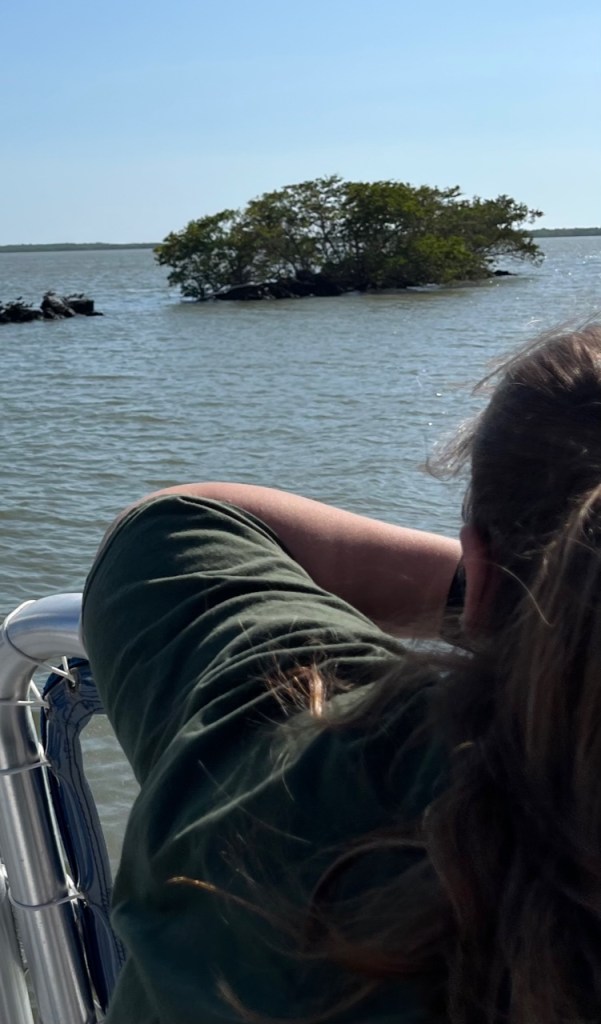
These mangrove shrubs spread by extending aerial roots down through the salt water into the soil. In Ten Thousand Islands, mangroves have formed about fourteen thousand islands, comprising one of the largest mangrove forests in the world. Photo by Katey Batavia.
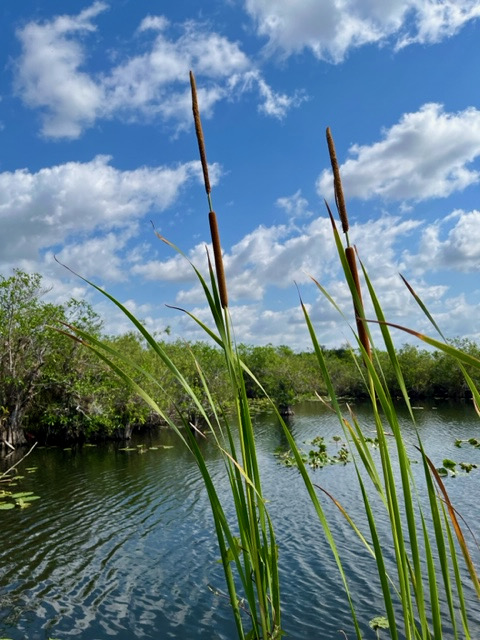
Cattails and mangroves growing along the Anhinga Trail, Everglades National Park, Homestead, Florida. Photo by Ellen Maher.
Havana/Miami mural at Havana Spice Restaurant portrays the family’s emigration to the US. Photo by Katey.
Light and crispy fried plantains at the Havana Spice Restaurant. Photo by Ellen.
Chickee hut breakfasts,
stone crab claws, Cuban cafes,
Indian fry bread.
A rooster turns a tortoise into a taxi at Robert is Here.
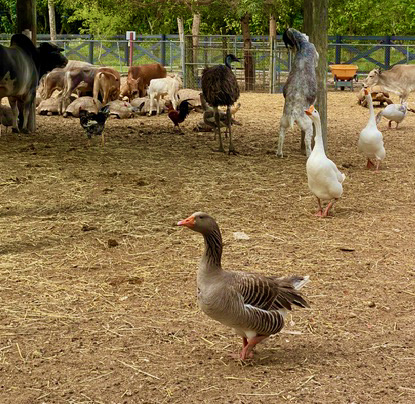
Geese on parade at Robert is Here.
Goats at Robert is Here seem to be having a difference of opinion, or maybe they are competing for the affections of the cute goat watching them from above.
Turkeys, tortoises,
emus, chickens, geese, and goats
at “Robert is Here.”
We enjoyed the fruit we bought at Robert is Here. Ellen made this fruit platter to go with cheese omelets Cheryl cooked for breakfast back home in Port Charlotte. Photo by Ellen.
Cheryl likes the antique tractors at Robert is Here. Photo by Katey.
Honey, candy, fruit,
antique tractors, kiddie cars
at “Robert is Here.”
Sunset at Gulf Coast Visitor Center, near Everglades City, Florida. Photo by Ellen.
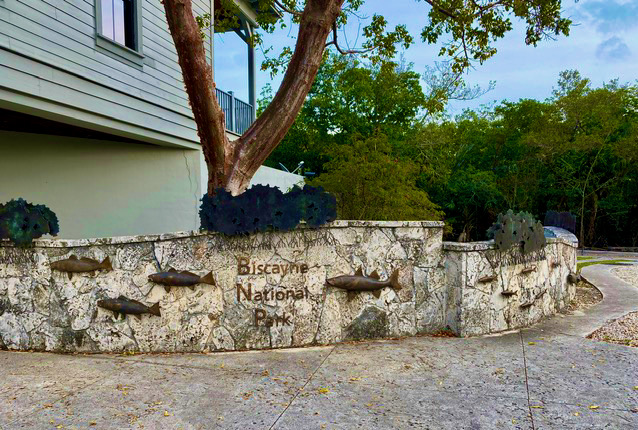
Katey, Ellen, and Cheryl… wet and windblown after an exciting cruise on Biscayne Bay. Visitor center at Biscayne National Park.
Photo memories
of joyous days together.
Back home to Robert.
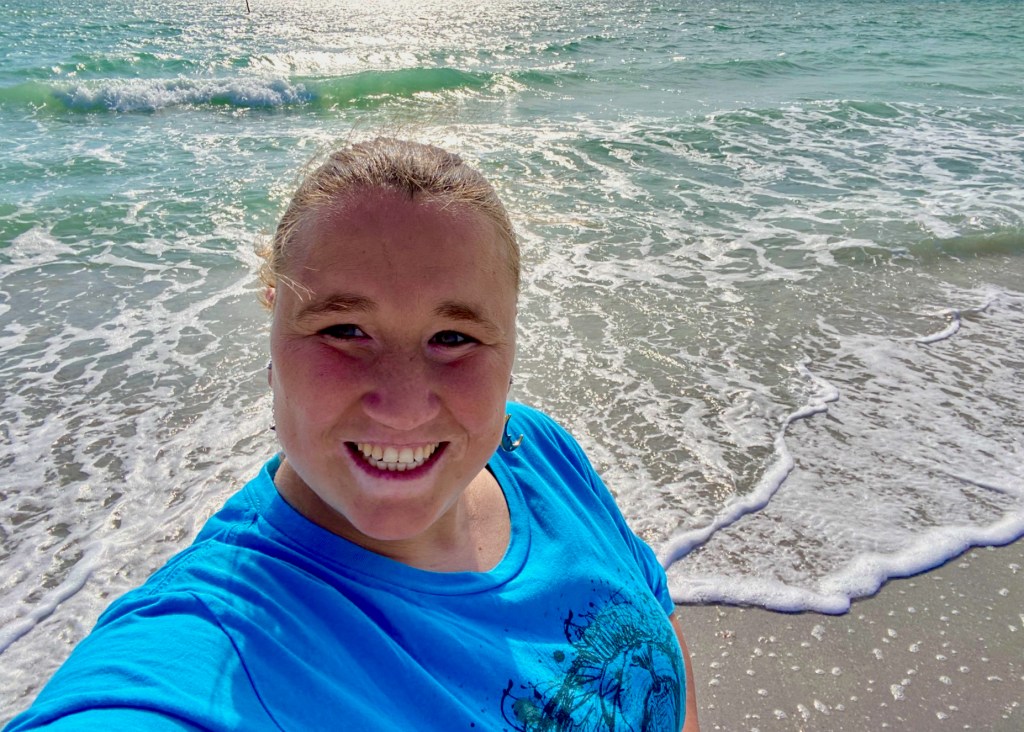
Katey takes a selfie at Englewood Beach.
Ellen captured this view of the surf at Englewood Beach.
Lunching with Robert
at breezy Englewood Beach.
Great day for a swim!
I wonder what antics the goats are up to back at Robert is Here. Are they remembering Katey and all the romaine lettuce she fed them? Photo by Katey.
Bye, Ellen, Katey…
warm smiles, warm hugs, warm wishes…
Safe trip! Come back soon!
The majority of these photos were taken by Ellen Maher and Katey Batavia with their i-phones. I am not sure who took some of the photos. A few photos were taken by Cheryl Batavia and kind volunteers. Thank you to Katey for emailing the photos to me.
Thank you to Ellen for driving several thousand miles on this trip.
Thank you to both of my daughters for making it possible for me to take a trip I could not have taken by myself. They were wonderful company!
The visitor center has a beautiful short boardwalk among the mangroves and superb indoor and outdoor exhibits about the history and ecology of the area.
Also available: backcountry hiking and camping.
Everglades National Park
We enjoyed the Ten Thousand Islands Boat Tour at Gulf Coast Visitor Center. Our guide explained the history of the area and gave information about various plants and animals we saw.
Also available are boat tours at Flamingo Visitor Center, the only place in the park to see flamingos and saltwater crocodiles. Shark Valley Visitor Center features a tram tour and an observation tower. Anhinga Trail and Gumbo Limbo Trail are at Royal Palm Visitor Center. Kayak and canoe rentals and tours are available at several locations in the park.
Biscayne National Park
Most of this park is underwater. We enjoyed a boat tour to Boca Chita Lighthouse. We spent an hour touring the lighthouse and the island, once part of the Deering Estate. Our guide gave a very interesting history of the park and talked about the environmental challenges the park is facing due to rising sea levels. We saw Turkey Neck Nuclear Power Plant in the distance and learned that the power plant is surrounded by warmer water that sustains a population of saltwater crocodiles.
Also available are snorkeling and diving tours where you can explore shipwrecks on the bottom of Biscayne Bay.
Robert Is Here, Homestead, Florida
This is a fruit stand founded by Robert in 1959 when he was six years old. Robert still works at his fruit stand, which features locally-grown vegetables and about one hundred varieties of locally-grown exotic tropical fruits, some from Robert’s own farms. Service is friendly and helpful. They made sure that we had chosen the best fruit and packed it on ice to make sure it got home safely. There is also a huge assortment of raw Florida honey, preserves, candy, and baked goods.
You can enjoy a lunch of tropical fruit smoothies and pulled pork barbecue while you are here. The fresh coconut water is awesome!
On the premises is a large animal enclosure where you can feed giant tortoises, Brahma calves, emus, chickens, geese, turkeys, and goats. Ellen had the emu eating pellets out of her hand. This is the most beautiful animal enclosure of its kind that I have ever seen! There is also an aviary with tropical birds and parrots who like to converse with visitors. Scattered throughout the grounds is Robert’s collection of antique tractors. Tricycles and kiddie cars are provided for young visitors to ride.
Miccosukee Indian Village
Outdoor exhibits are located in several chickee huts and demonstrate traditional Miccosukee life. There is an alligator show and an observation platform overlooking the marsh. There are picnic areas and a small indoor museum of Miccosukeee history. The gift shop displays hand-crafted traditional clothing and jewelry, books, and other souvenirs.
Across the road, you can take an airboat tour of the “River of Grass.” I have taken many classes to visit the village and to take an airboat tour. The guides were always knowledgeable and informative. Here, as in the national parks we visited, you will learn about preserving the natural environment.
Indian villages are scattered throughout Everglades National Park along US 41. There are multiple airboat operators and some small restaurants featuring traditional Miccosukee cuisine. Alligator and Indian fry bread are likely to be included on the menus.
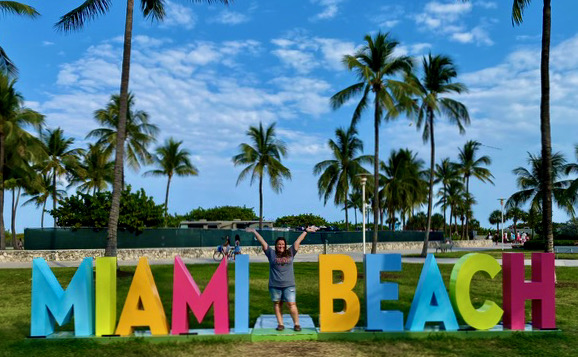
Miami/Miami Beach
The beach is still lovely, but crowded and noisy. I did not enjoy the loud music, pervasive Jamaican cigar and marijuana smoke, constant racket of small planes flying up and down the beach advertising parties at local night clubs, and incessant chatter of other beachgoers. If you go to Miami Beach, you will see a lot of Brazilian bikinis and maybe some bare bosoms. Be prepared for horrendous traffic and very steep prices. We paid $20 for two hours of valet parking, $20 to rent an umbrella, and $20 to rent a chaise lounge. A large bottle of Pelligrino sparkling water was $9.
If you have a big budget and lots of time to spend, there are many great attractions in the surrounding area. I have listed a few that I enjoyed in the seven years I lived in Miami Beach and at various times in the twenty years since then:
Bayside in Miami, Miami Beach historic art deco district, Lincoln Road Mall in Miami Beach, Miami Beach Convention Center, Miami Jungle Gardens, Fairchild Tropical Gardens, Viscaya mansion and grounds, a gorgeous world-class concert hall and opera house in Miami, Miami Beach Ballet Company, Miami Beach Symphony, Miami Metro Zoo, Miami Seaquarium, and boat tours featuring celebrity homes on the islands. Miami holds an annual book fair which I attended five years ago.
There are glitzy, huge new cruise terminals. If you are a sports fan, you might enjoy Marlins baseball or Miami Dolphins football. If you like to wager, consider nearby jailai or horse racing.
This list just scratches the surface of things to discover in Miami/Miami Beach.
South Florida Restaurants We Love
Triad Seafood Market and Waterfront Cafe, Everglades City, Florida
We ate outside overlooking a lovely water view. Ellen and I split an order of very fresh stone crab claws with mustard sauce. Our hush puppies and sweet potato fries were great! We enjoyed a delicious salad composed of spring mix, walnuts, dried cranberries, red onions, tomatoes, and blue cheese dressing. Katey, not a fan of seafood, ordered a cheeseburger and salad, which she said were very good.
Roasters ‘N Toasters New York Deli, Miami Beach, Florida
Ernie and Richie’s was our neighborhood Jewish deli when we lived in Miami Beach twenty years ago. Roasters ‘N Toasters replaced it and maintains a similar vibe and menu. Katey and I split a delicious Reuben on rye sandwich. My Caesar salad came with a homemade garlic dressing. Ellen’s chopped liver sandwich was intensely flavored and good. The carrot cake with cream cheese icing that we shared had many thin layers and was suitably decadent. The flakey rugelach cookies were made with dark chocolate and flavored with cinnamon. Katey and Ellen liked the matzo ball soup. We all loved the well-prepared latkes with sour cream and apple sauce.
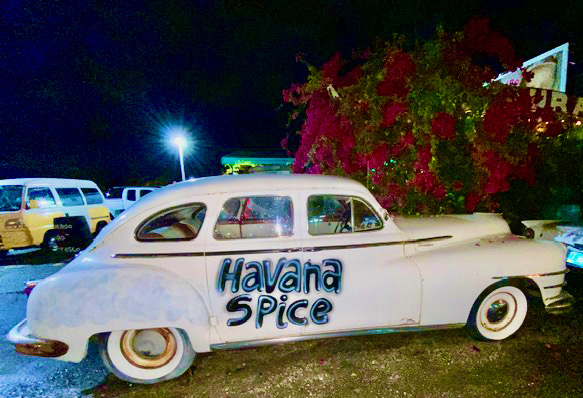
Havana Spice Restaurant, Homestead, Florida
This is a really wonderful Cuban family restaurant with fun, funky decor. We ate there twice. Ellen and Katey enjoyed Cuban coffee and expresso. I ordered my favorite, lechon asado (Cuban roast pork.) It is marinated with mojo (bitter orange) sauce and slow-cooked with onions. I also liked their maduros (fried ripe plantains.)
The second time we ate there, Ellen and I shared a big plate of sliced fried plantains that were unbelievably light and crispy. I tried guava cheesecake, which was very sweet. I wished I had gotten my favorite, flan (baked egg custard.) It looked great in the dessert case!
*Having gained several pounds on our vacation, I have returned to my usual low-carb diet.



































 Gulf Coast Poet