My daughters, Ellen and Katey, on the bayfront terrace of Ca’D’Zan, the 1920s Venetian-style mansion of John and Mable Ringling. They lived and entertained in this home for 90 days a year during the winter. Sarasota was the winter home of the Ringling Brothers, Barnum and Bailey Circus for many years. A luxury private railway car, The Wisconsin, was John and Mable Ringling’s home for much of the year as they traveled around booking acts for the circus. The car, complete with stained glass, can be toured in the Circus Museum.
The mansion features stained glass windows, hand-carved, hand-decorated ceilings, and antique furnishings. My favorite room is the ballroom with its beautiful wide plank floors and gorgeous ceiling depicting dancing couples from different eras. The main room of the mansion is several stories high and has a view of Sarasota Bay through pastel-colored stained glass windows. The room has an ornate grand piano and a pipe organ that cost $25,000 in the 1920s.
Mable Ringling’s wagon wheel-shaped rose garden has approximately 1,250 antique roses, many from the 17th and 18th centuries, and is surrounded by statues of courting couples.
The sixty-six-acre estate has numerous other gardens and several museums. We spent about half a day exploring the mansion and the Circus Museum on this trip. Multiple galleries feature priceless circus memorabilia. There are elaborately hand-carved and painted antique circus wagons, calliopes, gorgeous vintage costumes made of silk and embroidered with faux gems, old circus photos, and informative and entertaining videos.
There is a 31-gallery art museum famous for its world class collection of old masters. Besides its permanent collections, the art museum hosts various exhibits. I have visited the art museum several times in the past. You could easily spend a day there. There is also an historic theater which hosts live performances.
Katey takes a selfie in front of one of the fourteen banyan trees on the estate, a gift from Thomas Edison, who raised several types of banyan trees at his winter estate in Fort Myers, Florida. In the photo: Katey, Cheryl, and Ellen.
Unless stated otherwise, photos in this post were taken by Katey Batavia and Ellen Maher.
Sculpture above the entrance to the Circus Museum.
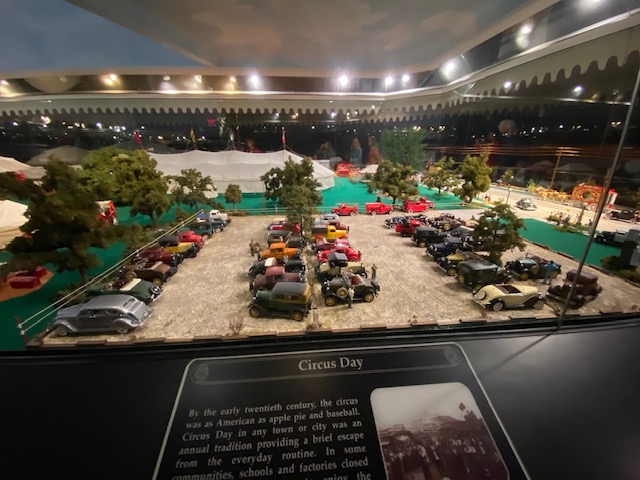
A scene from the Howard Brothers Model Circus, which recreates an early 20th century circus. Howard Tibbals, a retired circus performer, created the 44,000-piece display by hand over a fifty-year period. The display occupies 3,800 square feet in the museum.
Multiple acts took place simultaneously under the big top.
Animal acts and the menagerie allowed many people to see exotic animals for the first time.
The menagerie.
A circus parking lot filled with beautifully-crafted vintage cars. Schools and businesses shut down on circus day so that people for miles around could attend the circus.
There were side shows where people could entertain themselves with novelty acts as they waited for the circus to start under the big top. The circus train carried the circus from town to town. When set up, the circus was like a small city. It took over a thousand workers to set up the circus and take it down. They could set the circus up in four hours for the day’s performance. Then they would tear it down and set up again in the next town. Most performances lasted only one day.
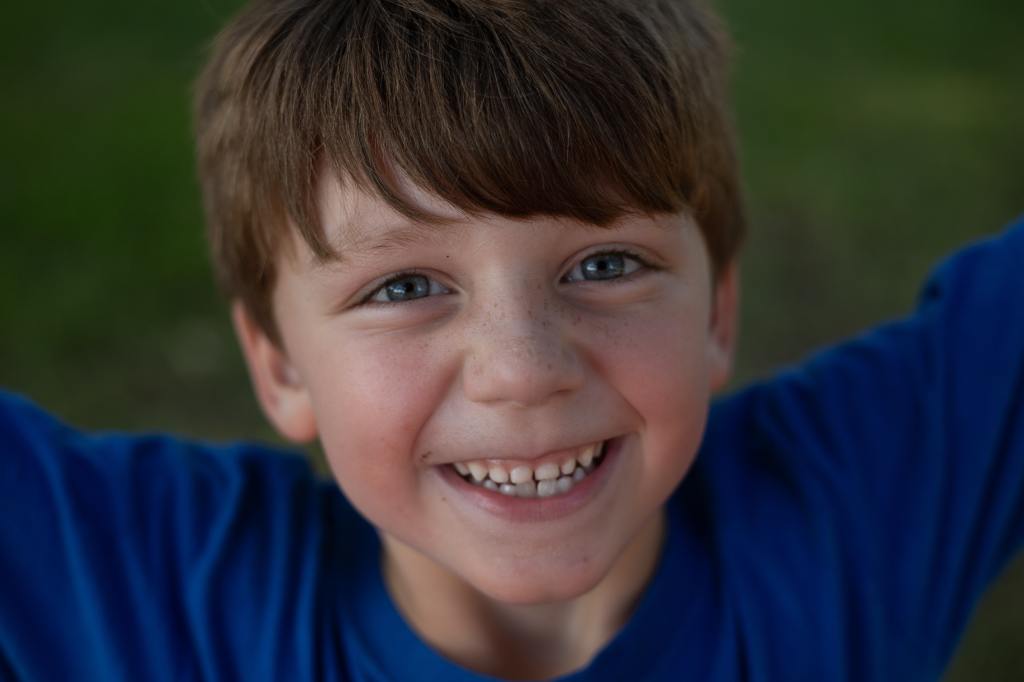
Young boys and girls all across the country loved the glamour and excitement of the circus. Many had big dreams of joining the circus someday.
A Young Boy’s Circus Dreams
Photo by Jeremiah Lawrence from Unsplash.
A Young Boy’s Circus Dreams
I’ll join the circus!
A ringmaster in top hat
and tails, I will say…
“Ladies and gentlemen! Children
of all ages! Welcome!”
I’ll join the circus,
ride an elephant bareback,
and teach bears to dance.
Lions and tigers will purr
when I crack my whip and grin!
I’ll join the circus,
a goofy clown…folks laughing,
watching me fall down.
I’ll honk my red nose, driving
crazy in my tiny car!
I’ll join the circus!
Wearing flashy spangled tights,
I’ll walk the high wire,
and catch flying girls from my
high trapeze…Crowds will go wild!
I’ll join the circus
and see the world from a train…
each day, a new town!
I’ll come home for vacation…
fish all day…eat Mom’s peach pie.
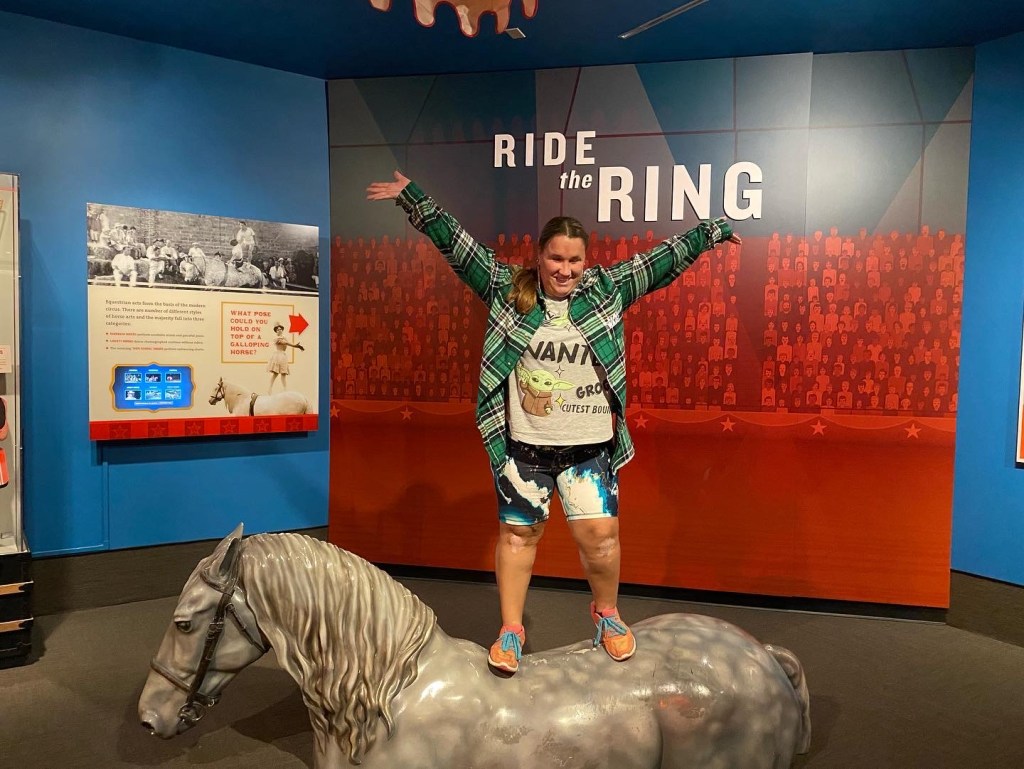
Ellen in a tiny car in the interactive exhibit.Katey, trick rider, interactive exhibit.
Upcoming posts will feature more adventures from our travels during Thanksgiving week. It was so good to see my daughters again, and we had a fabulous time!
For more information about The Ringling Museum, visit their website, ringling.org
A Poem about Hanukkah, a Jewish Holiday beginning this year on November 28
Jews celebrate the eighth night of Hanukkah. Eight candles burn in a menorah. The ninth candle in the center is used to light the other candles. Photo by Rodnae Productions from Pexels.
“A Great Miracle Happened Here!”
Hanukkah menorah lights burn bright.
Just one candle is lit on the first night,
two on the second, three on the third…
On the last night, all eight are burned!
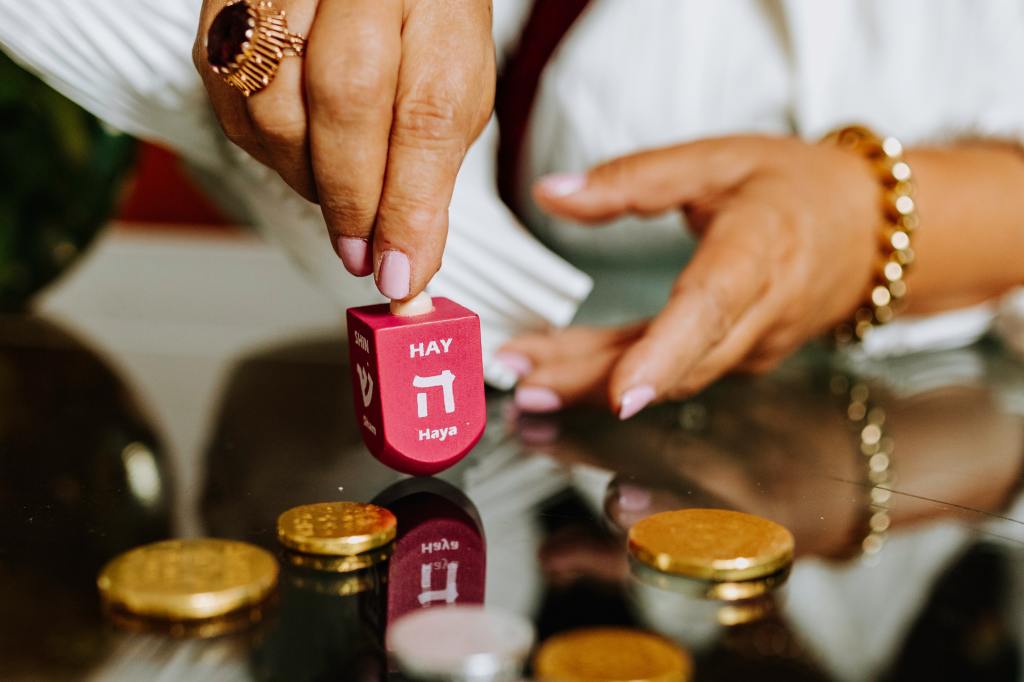
A woman gambling for Hanukkah gelt, spinning a dreidel. The letters inscribed on dreidels stand for, “A great miracle happened here!” Photo by Rodnae Productions from Pexels.
Spin the dreidels…Their message is clear:
“A great miracle happened here!”
Tell the Hanukkah story, please,
of Jerusalem reclaimed by the Maccabees.
Drawing the Star of David. Photo by Cottonbro from Pexels.
In Jerusalem, the temple’s rededication
was cause for joyous celebration.
They had enough oil to burn for only one day…
but for eight days, the temple lamps blazed!
Photo of a violinist by Cottonbro from Pexels.
Bring out the latkes, sing the songs.
Hanukkah celebrations are eight days long!
Love of religious freedom is heartfelt,
holiday memories as sweet as Hanukkah gelt!
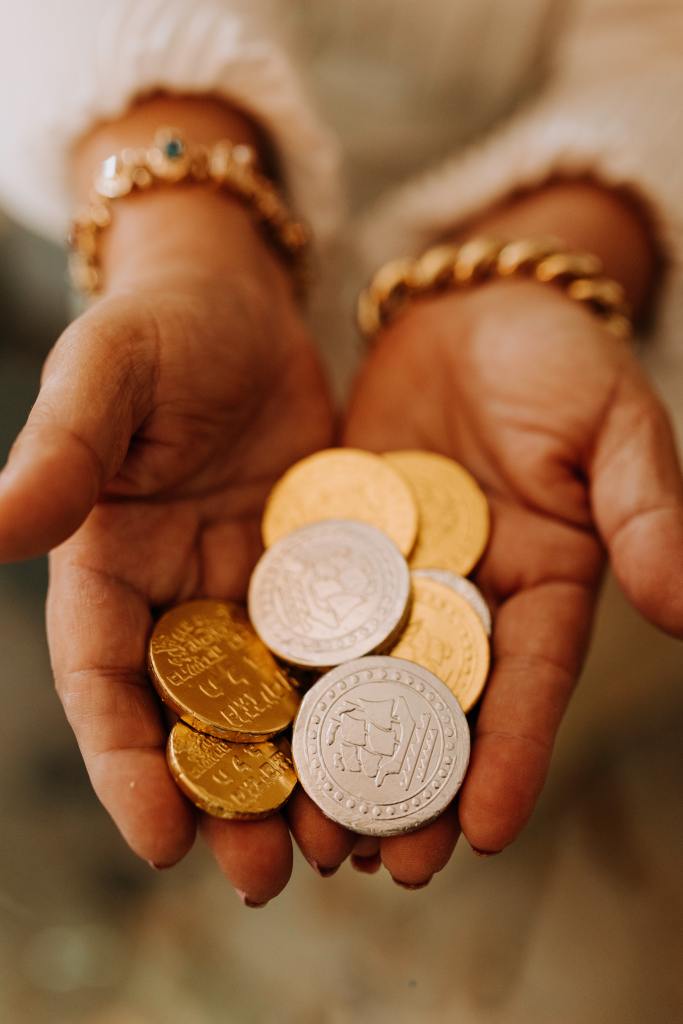
Hanukkah gelt, chocolate coins covered in foil. Photo by Rodnae Productions from Pexels.
The events commemorated by Hanukkah occurred about 167 BCE. The history of the period is very complex, but well worth learning more about. I especially like the story of Judith, a spy who helped win the war to reclaim Jerusalem. Hanukkah is generally viewed today as a celebration of religious freedom.
My daughters, Ellen Maher and Katey Batavia will be visiting over the Thanksgiving week, November 21-27. I am so excited to see them for the first time in almost two years! I will be off WordPress to spend some time with them. A swim with the manatees at Crystal River is planned. It was canceled last time because of Covid 19. We are eagerly looking forward to the trip.
The poem above was written by Ellen. She is an ordained Baptist chaplain and a teacher and administrator in a recovery program that deals with issues such as grief, addiction, and illness. She also volunteers for many special projects at her church. This year she helped to produce a video for a virtual Vacation Bible School during the pandemic. Ellen writes religious poems on her blog, Echoes of the Lion’s Roar.
HappyThanksgiving!
West Indian Manatee. Photo by Maegan Luckleish from Unsplash.
One Saturday about forty years ago, when my husband was at work, my young daughter, Ellen, and I watched fire and smoke moving down the mountainside toward our house. We packed our car with something irreplaceable…our photo albums. My fifty-two-year-old daughter still has those albums, memories of her childhood.
An Album of Childhood
Photo by Joice Kelly from Unsplash.Photo by Romina Veliz from Unsplash Photo by Josh Applegate from Unsplash.Photo by NeonBrand from Unsplash.
Photo by Deb Dowd from Unsplash.
Photo by Prince Abid from Unsplash.Photo by Robert Collins from Unsplash.
Many people are wondering whether it is too late to restore the environment to health. I don’t know the answer, but I HOPE that it is not too late! The poem below is the last of my three environment-themed Halloween Sonnets.
I Remember Rainbows
I live today on earth, a shabby place,
in dreary post-apocalyptic haze,
but I remember glowing rainbow hues,
and sunny skies above, quite clear and blue,
and even if my skies are grey today,
lush rainbow colors flood my dreams always!
No fish are swimming in polluted streams;
in dreams, clear rivers flow to shining seas.
No birds are singing in the leafless trees,
but dream-birds nest in trees of verdant green!
Though even weeds can’t bloom in sterile clay,
I dream of vivid flowers every day
where dream-bees feed in joyous, playful scenes,
and I remember rainbows in my dreams.
Photo by Angelo Casto from Unsplash.Photo by Nuno Antunos from Unsplash.
Burned-out boat on display at Bombay Beach, a ghost town by the Salton Sea in California. The Salton Sea is a dead body of water that is slowly drying up, and the town is now a sort of art museum. Photo by Design Class on Unsplash.
Ingrid’s Halloween Sonnet Festival inspired me to learn to write sonnets. Few things scare me more than the impending doom of global warming, climate change, deforestation, species extinction, and pollution. We need to change our ways NOW if we hope to prevent the ubiquitous doomsday predictions from coming true.
Check out the Halloween Sonnet Festival on Ingrid’s blog, experimentsinfiction.com!
A Vintage Conestoga wagon with a water barrel on the side. Photo by Larry Costales from Unsplash.Map of US Territorial Growth. Photo from flickr.
Timeline: 1783-1869
1783
The Thirteen Colonies won their independence from England. The United States of America at this time consisted of thirteen states which extended to the Mississippi River on the west. Territories to the south and west were controlled by Spain, France, and Russia. Canadian borders were being established to the north. Of course, Native Americans already lived in the Americas when Europeans arrived, a fact Europeans often chose to ignore.
Mountain men were fur traders and trappers who explored the American West. They lived among the Native Americans, learned tribal languages, and often married Native American wives.
1803
The Louisiana Purchase. The US bought the Louisiana Territory from France. President Thomas Jefferson sent the Lewis & Clark Expedition to explore the West. Their journals recorded the topography, Native American tribes they visited, and plants and animals they found.
Sacagawea, a sixteen-year-old Native American guide and translator, joined the expedition with her French Canadian explorer husband and infant son. She was invaluable to the expedition, and in 1794, a one dollar coin was first minted in her honor. On the coin is an image of Sacagawea carrying her baby on her back.
1803-1841
The Western Expansion. Settlers moved to land West of the Mississippi River, traveling on foot, on horseback, and by canoes, river rafts, and Conestoga wagons.
The US continued to purchase territories. A doctrine called “Manifest Destiny” stated that it was ordained by God that the US should occupy all the land from the Atlantic Ocean to the Pacific Ocean.
Native Americans resisted the takeover of their land. There were many conflicts and wars between the Settlers, US soldiers, and the Native Americans. US soldiers manned numerous forts along the trail to protect the wagon trains and the settlers who now lived on the Great Plains.
1841-1869
The Great Migration. During this time, 350,000 settlers traveled to California and the Oregon Territories. Steam-powered riverboats and eventually stage coaches became available. Telegraph lines soon linked East and West. The US now stretched from the Atlantic Ocean to the Pacific Ocean.
Many new states had been admitted to the Union as settlers moved west, some where slavery was legal, and some where slavery was illegal. This was a tumultuous time in American history which culminated in a bloody civil war.
1849
Gold was discovered in California, and the California Gold Rush began. “Forty-niners” went to California in search of gold. A few of them did “strike it rich.” Many more did not.
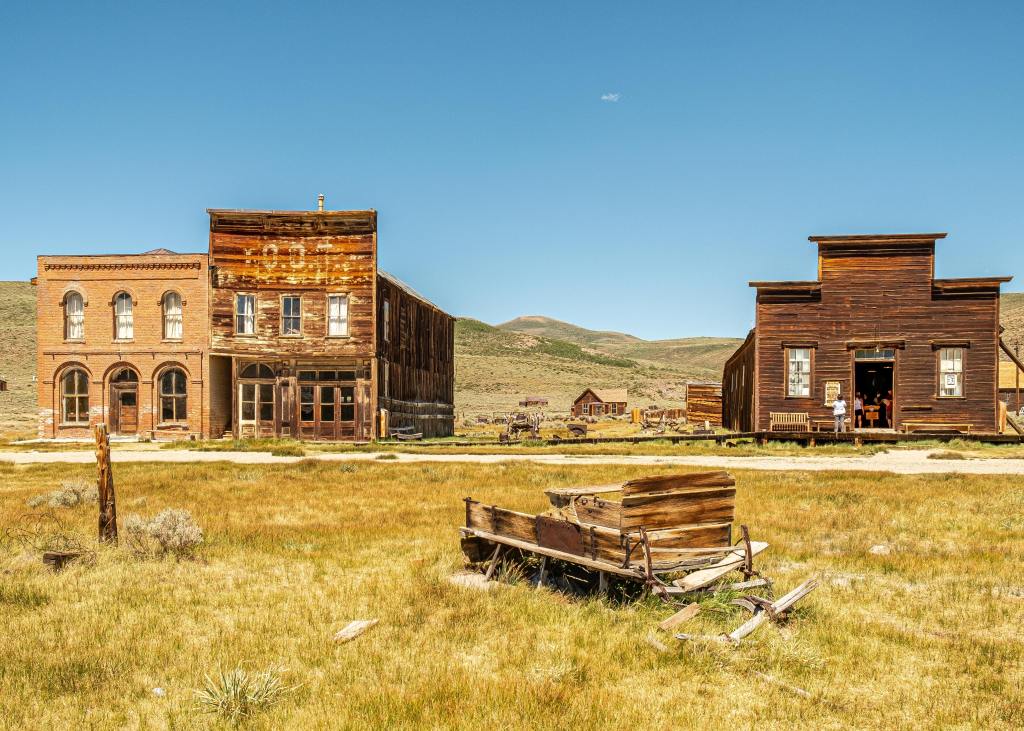
Towns sprang up where gold and silver were discovered. When the mines played out, the towns were abandoned. Ghost Towns still exist in the American West.
1861-1865
The American Civil War was fought between the Union (Northern States) and the Confederacy (Southern States.) It was a devastating and bloody conflict that centered around issues of slavery.
1869
The First Transcontinental Railroad was completed, joining East and West. This marked the end of the Era known as the Great Migration.
A creek in Yosemite National Park. Photo by Michael Hirsch on Unsplash.
Mountain Men
Mountain men roamed the wilderness
and lived among the tribes,
learning tribal languages
and taking native wives.
They knew the animals and seasons
and walked the forest ways,
trapping beaver along the rivers
in long, solitary days.
Gentlemen in London and Paris
wanted to make the right impression.
American beavers died for the sake
of fashion’s beaver hat obsession.
Mountain men gathered
when the season was through
to trade their furs and celebrate
their yearly Rendezvous.
Black Foot, Standing Bear, and Big Eagle, three members of the Sioux tribe. A Sioux village with tipis, 1898 photo from the Boston Public Library on Unsplash.
Native Americans
Native Americans, on many occasions,
helped European settlers survive,
but goodwill soon evaporated
when the multitudes arrived.
An endless stream of intruders
settled on ancestral lands.
Smallpox and measles took a toll.
Others died by White men’s hands.
Native Americans were pushed
further westward for years and years.
Their lands were seized, and they were
forced to walk the “Trail of Tears.”
Treaties dishonored, promises broken.
Natives were confined to reservations.
Their children were sent to far-off schools
for White man’s education.
Modern-day campers and a replica Conestoga wagon. Photo by Randy Fath on Unsplash.
Wagon Trains Go West
Carrying the settlers’ worldly goods,
Conestoga wagons crossed the plains.
For protection against Native American
attacks, they traveled in wagon trains.
A wagon master led the wagon train
and guided settlers on their way.
He knew where to ford the rivers and
where to camp at the end of the day.
Many settlers walked along the trail
to spare the oxen and lighten the load.
At night they circled the wagons and
cooked their suppers beside the road.
Babies were born along the trail.
Settlers played music and danced.
Couples were married on the journey
after a wagon train romance.
Dreams were big, and hopes were high,
but there were hardships every day.
The trail was littered with broken wagons,
and graves were left along the way.
Vintage steam engine. Narrow gauge railroad. Photo by Adrienne Merritt on Unsplash.
The Great Migration
The US army manned a series of forts
to defend the wagon trains
and protect the settlements springing up
across the western plains.
Gold was discovered in California.
Settlers traveled the Oregon Trail.
Stage coaches soon headed west,
carrying passengers and mail.
New states were joining the Union,
some slave, and some free.
It was a dark and turbulent era
in American History.
Five years of civil war
brought widespread devastation.
The Transcontinental Railroad
ended the era of Great Migration.
There has always been a special bond between a cowboy and his horse. Photo by Rodnae Productions on Pexels.
Cowboy Life
Cowboys riding the open range
under a wide blue sky,
we keep an eye out for rustlers,
loaded guns by our sides.
Many more miles to ride,
many new calves to brand.
We sit around the campfire,
eating beans from a can.
Singing sad songs, swapping
tall tales, just hanging around.
We unpack our bedrolls
and fall asleep on the ground.
Morning comes early. Drink your
coffee and saddle your horse.
Looks like good weather today…
I’ve seen a whole lot worse!
New horses to be broken
out in the corral.
Getting ready for round-up
and a big cattle drive in the fall.
Cookie’s got provisions.
The chuck wagon’s ready to go.
Our last night in the bunkhouse…
Telling jokes and playing dominoes.
This cattle drive is endless,
riding hard and swallowing dust,
eating biscuits and gravy
until we’re ready to bust!
Tomorrow, we’ll drive the herd
to town, and head for the saloon.
We’ll play some cards, drink some
beer, and listen to some tunes.
A modern-day riverboat on the Mississippi River near New Orleans. Photo by Bernard Sprague from flickr.
Scoundrels of the Old West
Scoundrels were irresistibly drawn
to the riches of the West.
Card sharks prowled the riverboats,
putting amatures to the test.
Traveling medicine shows
sold worthless potions and elixers
to an unsuspecting populace.
What a shameless bunch of tricksters!
Claim jumpers lurked in the gold fields
to seize somebody else’s claim.
Crooks in preacher’s collars robbed
congregations in God’s name.
A few crooked agents on reservations
sold cattle the government sent,
growing rich on the profits, while native
families ate the bread of discontent.
Unscrupulous prostitutes robbed
customers who fell into their hands.
Rustlers stole cattle on the range,
altering the original brands.
And then there were armed outlaws
committing robberies with guns,
holding up stages, trains, and banks,
living their lives on the run.
Vintage western schoolhouse/church. Photo by Dan Myers from Unsplash.
Into the West, a six-part series from executive producer, Steven Spielberg. Available on YouTube.
Two families, one Native American and the other White, live through the events of the American westward movement.
Little House on the Prairie, TV series based on the Little House series of books by Laura Ingals Wilder. Story of a family growing up on a farm near a small prairie town.
Michael Landon, Mellissa Gilbert, Karen Grassle, Melissa Sue Anderson.
Bonanza, TV Series. A rancher and his sons are involved in many issues of the day.
Lorne Greene, Michael Landon, Pernell Roberts, Dan Blocker.
Oklahoma, a movie musical about a girl coming of age on an Oklahoma farm.
Shirley Jones, Gordon McRae.
Paint Your Wagon, a movie musical comedy set in a Gold Rush mining town. A Mormon woman marries two men.
Clint Eastwood, Lee Marvin, Jean Seberg.
Seven Brides for Seven Brothers, a hilarious movie musical with critically-acclaimed dance sequences.
Howard Keel, Jane Powell.
Jeremiah Johnson, a movie that tells the story of a mountain man and his encounters with grizzly bears.
Robert Redford, Will Geer.
Dances with Wolves, a movie about a Civil War hero who is eager to see the old West and is assigned to a fort. Arriving at an abandoned fort, he gets to know a local tribe of Native Americans. He spends time in their camp, going on a buffalo hunt and falling in love with a white woman who lives with them.
Directed by and starring Kevin Costner.
River of No Return, a movie about danger, romance, and redemption on a river raft headed west.
Robert Mitchum, Marilyn Monroe.
Sarah Plain and Tall, movie. A mail order bride from New England becomes part of a farm family in the West.
Glenn Close, Christopher Walken.
McClintock, a hilarious western comedy movie reminiscent of Shakespeare’s “Taming of the Shrew.”
John Wayne, Maureen O’Hara.
Westerns on this List
The majority of the westerns on this list were chosen for authenticity. They allow the viewer to experience the American westward movement and life on the American frontier. Many of the westerns listed feature iconic actors and gorgeous western scenery.
Excellent documentaries about the old West have been made. Though they are not listed here, I like watching them.
The classic westerns listed are widely available on television, cable movie channels, Netflix, YouTube, Amazon Prime, and similar venues.
I hope you find something you enjoy!
For further information, try Wikipedia, a helpful source of information used for this post.




















 Gulf Coast Poet