Earthly Days in paperback and in the Kindle edition is now immediately available on Amazon, shipping in 1-2 days. It is also available on Barnes & Noble.
The paperback, because of the many color photos, had to be priced at $18.99. The Kindle edition, because it has no printing costs, is priced at $2.99. I priced the Kindle edition as low as possible to make it easy for all my fellow bloggers to enjoy the book. I would be ecstatically happy and eternally grateful for any reviews you submit, and I will share them on my blog as I have shared the review above.
Below is the Preface and Acknowledgements page from Earthly Days. I have recognized my WordPress friends for all you mean to me. Every poem in Earthly Days is better because of the experience, knowledge, and inspiration gained from my fellow bloggers. I am deeply grateful. Thank you so much for your support.
Thank you to those who have generously written such outstanding reviews and interviews. Your work is being used as a resource by my publisher in marketing Earthly Days. Your assistance in helping to launch Earthly Days is invaluable, and will be remembered always!
War crimes are defined by an international law called the Geneva Conventions, ratified by all member nations of the United Nations. War crimes have been reported to have been committed by Russia against Ukraine and by both sides in the War between Hamas Militants and Israel. This is a partial list of war crimes.
Attacking civilian targets, assaulting and killing civilians
Destroying buildings used for purposes of religion, education, art, science, and charitable organizations. Also, historic monuments and hospitals
Intentional starvation of civilians or impeding delivery of relief supplies to civilians
Kidnapping and hostage-taking of civilians, use of civilians as human shields
Rape, forced prostitution, and sexual slavery
Torture
Threats have been made by Russia to use nuclear weapons. Other forbidden weapons include poison gas and biological warfare.
References
United Nations Office on Genocide Prevention and the Responsibility to Protect
Topics: Genocide, Crimes against Humanity, War Crimes, and Ethnic Cleasning
United Nations Commission of Inquiry
This commission is investigating evidence of war crimes committed by all sides in Israel and occupied Palestinian territories since 7 October 2023.
Israel is being investigated for witholding food, water, electricity, and fuel in Gaza.
Hamas is under investigation for gunning down unarmed civilians, taking civilian hostages, and using civilians as human shields.
Animals in many places are responding to climate change by changing their behaviors. Warming seawater has resulted in a decrease in the number of krill, a tiny shrimp that is the primary food of humpback whales.
One group of whales have adapted by finding a new food source, salmon fry from a hatchery in British Columbia whose mission is to replenish the dwindling salmon population. One whale changed his diet from krill to salmon fry. He feasted when the salmon fry were released from their net enclosures.
Humans then started transporting the fry a mile away to release them. The whale followed the boat and adapted by learning to fish in the shallow water. Then he recruited a team of his buddies to fish in teams as dolphins do. I guess the hatchery will have to produce a much larger crop of salmon fry to feed the hungry humpback whales and still have enough salmon for human fishermen!
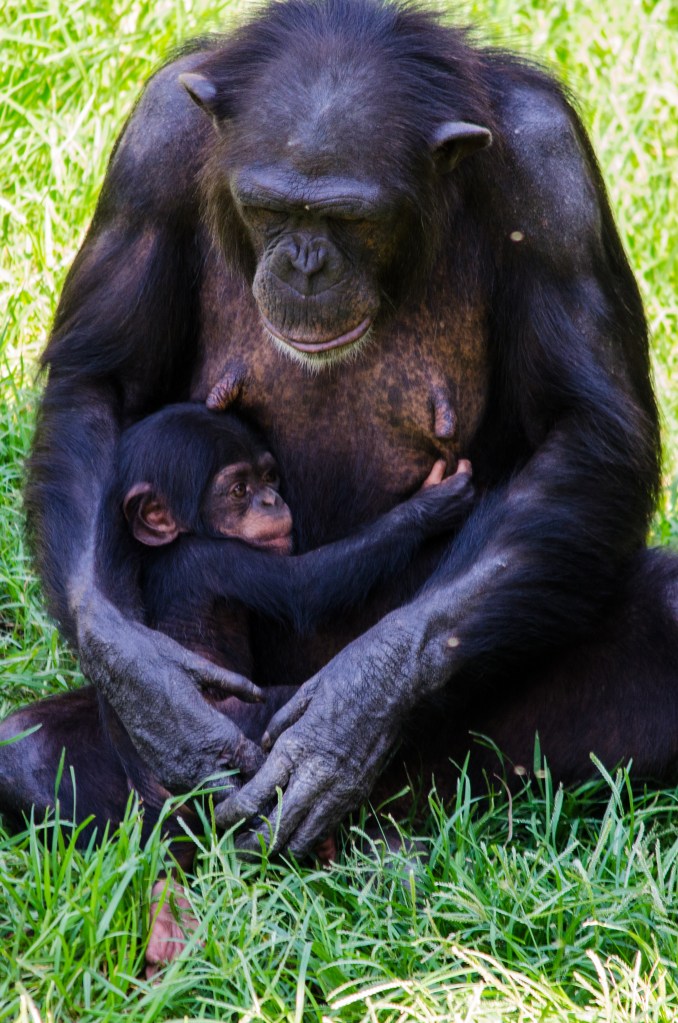
A group of forest chimpanzees migrated to the savannah of Senegal. The climate was hotter, there were fewer trees, and sources of food were far apart. The chimps responded to the heat by growing less body hair. They established larger territories. Because there were fewer trees, chimps spent more time walking upright than their forest relatives, who usually travel by swinging through the treetops.
Because there was less fruit to serve as a source of water, they had to find fresh water sources. To purify mucky water, they learned to dig holes in sandy riverbanks. When the water filtered through the sand, the holes were filled with clean water for the chimps to drink.
As a source of protein, the savannah chimps use twigs to fish for termites, spending much more time in this activity than forest chimps do. In the middle of the day, when weather is hot, these chimps seek shelter in caves, as early humans once did.
As the climate warms, the savannah will become many degrees hotter. Water sources will dry up. Life will become even more difficult for the savannah chimps. Will they be able to survive?
Marine Iguanas, famously studied by Charles Darwin, live in the Galapagos Islands, a harsh environment. To survive hot weather, they shrink their bodies. In cooler periods, they regrow to their usual size. Too long in cold water, iguanas face hypothermia, which can be fatal. Can marine Iguanas survive global warming?
For more information, watch the PBS video on YouTube, “Earth is Changing (and Animals are Adapting in Surprising Ways.)” Evolution Earth
My thanks to da-AL for inviting me as her guest on “Happiness Between Tails.” I hope you enjoy her informative and engaging post and my new poem, “Carbon Farming & Climate Change.” Check out the fascinating video about how carbon farming can restore worn-out soil, produce healthy food, reduce carbon dioxide in the air and water pollution from run-off, and combat global warming.
This poem was written in response to Ingrid’s EIF Poetry Challenge #8, and was awarded third place. My sincere thanks to Ingrid for posting the challenge on Experiments in Fiction and to Jaya Avendel of Nin Chronicles, who judged the challenge.
This is one of the poems that appears in Earthly Days.
The softcover edition, because of the many color photos is priced at $18.99.
The electronic version, which will also contain all the color photos, but without the printing costs, will be priced at $2.99 when it becomes available.
Celebrating the lives of our grandparents, whose positive influence has continued throughout our lives and in the lives of everyone who loved them. Photo by Jamie Street from Unsplash
Saying Goodbye to Our Grandparents
(Thirty Years Ago)
High on a hill, in a historic graveyard
overlooking a quaint Pennsylvania town,
we went to say our final goodbyes
to our grandmother.
After the crowd had dispersed,
my brother, sister, and I lingered.
We each threw a handful of earth
into the open grave.
There was something satisfying about doing that.
My grandmother had always loved growing things
in that Pennsylvania earth; she had placed a headstone
years before, planning to join my grandfather here.
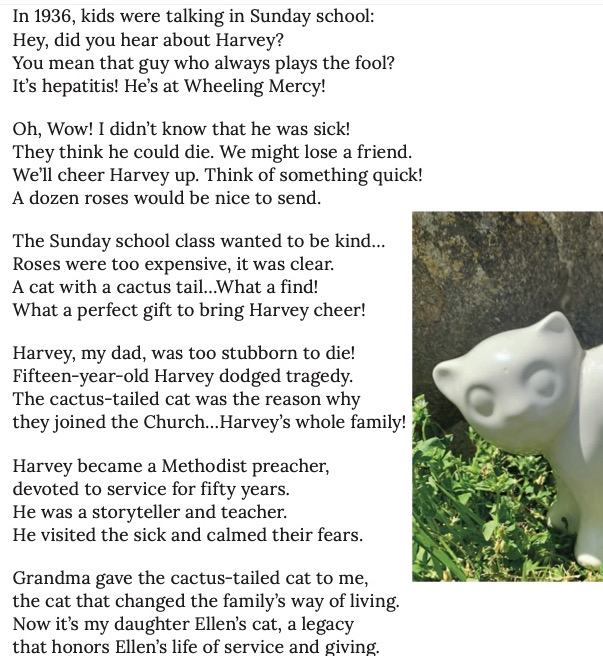
“Cactus-Tailed Cat” is one of the poems that will be appearing in Earthly Days. It was first published on this blog in 2020. In that photo, the cat had a tail made of a cucumber!
Here is the poem as it appears in Earthly Days with a new photo by my daughter, Eve Ellen Maher, the cat’s current owner. Ellen is an ordained chaplain, following in her grandfather’s footsteps. The cat now has a real cactus tail.
This is the second in a series of three posts aboutmypaternal grandparents.
Vintage Phonograph. Grandma was a “flapper” with bobbed hair and rolled-down hose, and she loved to dance! I don’t know how my grandparents met, but it might well have been at a dance. Maybe they listened to music on a phonograph like this. Photo by Sudhith Xavier from Unsplash.
Grandpa, born about 1898, worked in steel mills all around Pittsburgh, Pennsylvania as a young man. He bought an early car and travelled to Chicago to learn how to maintain it. There were no repair shops then. In a time when most people didn’t go to school beyond the eighth grade, Grandpa had graduated from high school. He loved to read and continued to educate himself throughout his life.
My grandmother, about ten years younger than Grandpa, was only able to attend school through second grade because she had to take care of her younger sisters while her single mother worked. At twelve years of age, she went to work as a hotel maid to help support her family. In her teens, she worked as a lifeguard. During her brief time in school, she had learned to read, and, like Grandpa, she continued to educate herself as long as she lived.
Earthly Days, is a collection of poems chosen from my blog posts over the last three-and-half years. My deep appreciation goes out to those who have posted reviews thus far. Watch for future reviews from your fellow bloggers. Check out their websites for outstanding content. If you missed their reviews of Earthly Days, you can find them at the URLs below.